General Update

I feel like it has been a while since I gave a proper update. This may be a bit disjointed as I hit the important points from the past few months.

  • 19 months sick. 1 year unemployed. 9 months on elimination diet. 8 months housebound.
  • The week before Easter, I had the best 4 days since becoming housebound. Starting April 1st, I went downhill and got no respite from the crash for over a month. Each day, I hoped for a new beginning. Each day felt as bad or worse than the day before. I was spending days in bed and, very quickly, my mood tanked. It is very hard to see the light at the end of the tunnel when you get no relief day after day. I am usually quite good at articulating what I’m feeling ~ what is worse, what would help ~ but, there was a point in late April, where I was lying alone in my room and all I could think was. “Help me.” I didn’t know who to call or what I would say. I didn’t know if I could speak ~ I had been crying for days and was at a point of hopelessness that made me mute. I managed to text E. who gave me a little pep talk and made me feel less alone. That’s all anyone can do. Things started to ease up the second week of May. I’m not back to my normal crappy baseline yet (no walking around the garden, no stretches), but my body feels a bit better and my brain feels like I’m a different person: As usual, as soon as I get some space from the symptoms, I bounce right back to someone who can talk and laugh and see a future.
  • Which brings me to what caused that crash: I think I got so much worse because I stopped wearing the cpap. I really didn’t believe it was doing anything except annoying me. The mask was waking me at night, the necessity of washing all the cpap parts was exhausting, the tape over my mouth wasn’t doing my skin any favours… But, it finally dawned on me that I got worse about a week after I stopped using it. And then I started to feel better exactly one week after I started using it again. So, I’m a believer. I may be aware of the cpap mask waking me, but I am not aware of the apnea awakenings and those are the ones that are really affecting my health.
  • Which brings me to my sleep: I am still having a rough time. I intend on writing a post detailing all the information and tips I have gleaned from various sources on how to improve sleep without prescription drugs, so stay tuned for that. For now, suffice it to say I have tried EVERYTHING. As I have mentioned before, I am addicted to reading the New York Times on my phone in bed before I go to sleep ~ but I wear amber-lensed, blue light-blocking glasses after the sun goes down so I am supposedly protected from the way the screen affects my brain. Well, my birthday night, instead of reading the NY Times, I spent far too long looking at Facebook and answering all the wonderful happy birthday posts. I forgot to wear my amber glasses and wound up staying awake until 6am, tossing and turning.
Zeo graph: These lines should be SHORT when I'm sleeping. The "W" at the top means "Wake".

Zeo graph: These lines should be SHORT when I’m sleeping. The “W” at the top means “Wake”.

This is very unusual for me ~ I always fall asleep right away, it’s the waking up throughout the night that is my problem. So, for the last two nights, I made a strict rule of no phone or computer screen of any kind after 8pm and no tv after 9:30pm. My sleep was instantly better. Look at last night:
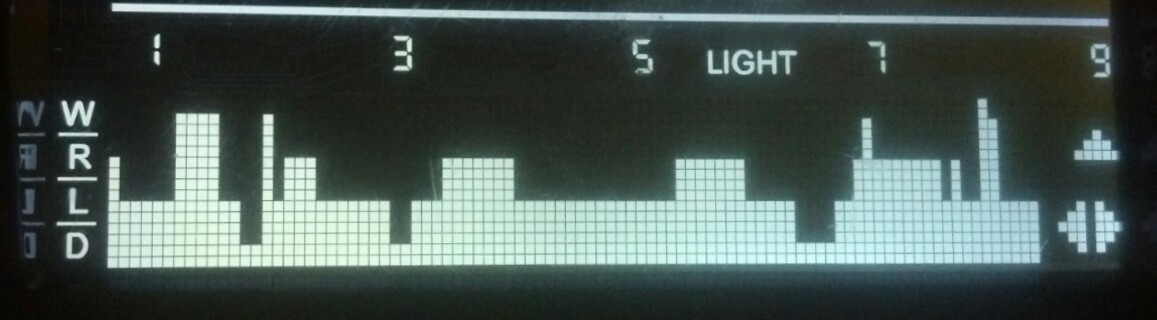
Proper sleep waves.

Proper sleep waves.

So, like the cpap, I believe I really underestimated what the phone or ipad light does to my brain. The room is black, but when I close my eyes I see lights, colours, moving lines, exploding stars. Basically, if I open my eyes it is darker than if I close my eyes. Someone on Phoenix Rising surmised that I was experiencing hypnagogia, stuck between wake and sleep. Either that or staring at my phone really, REALLY messes with my brain.

  • Which brings me to the supplements I am currently taking for sleep (and all the others, too, plus prescriptions). Here is my daily regimen:

2x Probiotic
2x tsp fiber
100mg Colace
Chinese Herbs (Lightning Pearls, currently 3/day)

2,000mg Acetyl L carnitine (1,000mg 2/day)
1,200mg Alpha Lipoic Acid (400mg 3/day)
4,000mg Borage Oil (960mg GLA) (2,000mg 2/day)
10,000iu Vitamin A
4,000iu Vitamin D3
2,000mg Fish oil (1,000mg EPA, 50mg DHA)
Vitamin B-complex (Thorne #12)
100mg CoQ10
400mg Magnesium glycinate
200mcg Selenium
400mg Riboflavin/B2
5,000mcg Biotin
15mg Zinc sometimes
500mg Vitamin C sometimes

Valerian sometimes
1mg Melatonin
100mg Phosphatidylserine
Tart cherry juice concentrate

5ml Zyrtec
Thyroid hormones
(T3 and T4)
Pantanase nasal spray
Clindamycin topical lotion
Miralax as needed
Albuterol inhaler as needed

  • The magnesium (for muscles), melatonin (for sleep onset), valerian (for relaxation), tart cherry juice (for pain and melatonin) and phosphatidylserine (to decrease nighttime cortisol) are specifically for sleep (I tried the Seriphos ~which is phosphorylated serine~ for a few weeks, but it seemed to keep me awake. The Good Doctor switched me to the new one). The other new additions to my protocol are biotin (the dermatologist told me to take this for the vertical ridges in my fingernails and hair loss) and the Chinese herbs. I stopped these for a week while I was feeling really terrible and thought I might be getting a cold, but it never materalised, so I started them again, increasing the dose much more slowly than I had originally.
  • My diet is still the same (no gluten, grains, dairy, legumes, tomatoes, potatoes, or eggs), but I think I am going to add rice any day now… I’ve just been waiting until I have a more predictable day-to-day baseline so I don’t blame crippling muscle pain (which happened on the 17th for one day only from head to toe for no apparent reason) or the disappearance of sleep or an extreme headache on a rice cake.

I want to write about my recent doctor visits and some of the amazing presents I got for my birthday, but not today. Just know that I am flying high with all the love and generosity that was showered on me. I keep saying it, but one more time: I am one lucky lady. I have the most compassionate and caring family and friends imaginable. I thought I always knew that, but I am truly humbled today. NOTHING matters but loved ones! In the end, they’re all we have.

What impact does ME/CFS Awareness Day have?

Here is a very interesting post by Patrick over at Quixotic: My M.E. Blog that I thought was worth reblogging here so my readers could mull over his questions:

What impact does ME/CFS Awareness Day have?

Did we make an impact?  It’s hard to know whether the message is spreading outside of our community or if we’re just passing the message around inside our own echo chamber.  I have to believe that we’re making small but steady strides, but it’s hard to make a big impact on public awareness when there’s so much noise competing for people’s attention.  And if we do get people’s attention, what exactly is our message?
 
I’ll get to that in a second, but first let me back up.
 
Sometimes I feel like there’s more that I could be doing to help our community.  Other times I wonder: isn’t it enough to just be looking out for myself and my family?  After tending to my own health issues, I’m not sure how much more of me is left to give to community issues.  I suspect that’s a feeling that many of us face.  So if we’re all struggling to get by, how do we build an impactful movement? 
 
And yet we all see these large, grassroots efforts being undertaken by other patient communities.  (Think MS, with its huge charity bike rides, funding drives, etc.)  Aren’t MS patients in a similar situation, with little leftover energy to give to the community?  
 
I suspect that the major awareness and fundraising efforts put forth by other patients communities are driven, in no small part, by the work of doctors, nurses, family, friends and loved ones who support the patients — not just the patients themselves.  So it begs the question: why not us?  Why haven’t we organized the same support network that would be essential for larger awareness and fundraising drives?  
 
Part of the reason is that our illness is so poorly understood that many of us can’t even get our own families to take it seriously (not counting me).   There’s this kind of frustrating circularity to our problem here.  
 
ME/CFS is very poorly understood in the medical community—>Why is it poorly understood in the medical community? —>  Because researchers can’t agree on the root cause or biomarkers? —>  Why can’t researchers agree? —>  Because there’s no research funding to chase promising leads —> Why is there no research funding? —> Because there are no major funding drives/charities/organizations —>  Why are there no major funding drives/charities/organizations? —> Because ME/CFS is not viewed as a “serious” illness by most —> Why is it not viewed as a “serious” illness by most? —>  Because ME/CFS is very poorly understood in the medical community —> [Back to the beginning.]  
 
So the challenge is to break this cycle.  These awareness campaigns are designed to break the cycle at the second to last step above: the “serious illness” step.  In theory then, having solved that issue, the remaining problems would gradually solve themselves in the reverse order, working backwords to the beginning of the list.  
 
But the thing to keep in mind is that the awareness campaign is only the first half of that step.  Why?  Because it’s not enough to just make people more aware of something.  People are never motivated to act on something merely by being aware that it exists.  An awareness campaign basically just primes people’s minds to be more receptive to the full message that follows.  It makes people curious enough to want to learn more.  
 
Then the question is, what are we doing to follow up on the awareness campaign?  What are we doing to educate people once they’ve become receptive to the message? 
 
So the next challenge is to develop our actual message.  Because you have to admit, we don’t really have a unified message.  We all have different levels of functionality, different theories of etiology, and we all seem to be pursing different treatments.  We confuse ourselves with our own cross-talk, so how are we supposed to present a unified, intelligible message to the average, healthy Joe?
 
That’s the next step.  That’s the challenge that I believe we need to be working on now.

Tomorrow is International M.E. Awareness Day.

Tomorrow is International M.E. Awareness Day. There are many events happening around the world, both online and in person. You can google your area to see if there is anything going on, but what I ask is something simple:

Please make an effort this month to talk about this disease. Look for opportunities to raise awareness. Don’t worry about being a “downer” or bringing up an awkward, depressing subject. Let people know that there is an illness that stops life in its tracks and has no approved drug treatments and very little funding for research. Explain that this has nothing to do with laziness, depression, tiredness or burn-out. Explain that there are test abnormalities, but doctors aren’t taught about the (possible/probable) etiologies of this disease so most do not recognise it and certainly don’t know what to test for or how to treat it. Make it known that patients languish in their homes ~ or, more likely, a family member’s home ~ are passed from dismissive specialist to thieving charlatan and back again, use up all their resources, and usually reach a point where they are trying to just survive because it is too exhausting to research treatments and search for medical help. Warn people that ME is often accompanied by crippling neurological issues, autonomic dysfunction, new allergies and multiple chemical sensitivity (MCS), postural orthostatic tachycardia syndrome (POTS), chronic migraines, irritable bowel syndrome (IBS), fibromyalgia (FM), mast cell problems (MCAD), sleep dysfunction and, of course, the depression and anxiety that would be hard to avoid with a diagnosis like this. These are all debilitating conditions in their own right, so drawing awareness to them is just as valuable.

As with many awareness campaigns, ribbons are worn to show support – blue for ME/CFS, purple for FM, and green for MCS. What I like about this is, it might bring up the conversation. Most people recognise the pink ribbon representing breast cancer awareness or the yellow Livestrong wristband which supports cancer survivors, but perhaps you will encounter someone who asks, “What does the blue ribbon stand for?” And then you can launch into your educational lecture. 🙂

meribbon

A few things going on around the world:

Niagara Falls will be illuminated in blue tomorrow, May 12th, from 9:45-10:00pm EST to raise awareness to M.E. From 10:15-10:30pm EST the falls will be purple for fibromyalgia (FM) and from 11:00-11:15pm EST the falls will be green to draw attention to multiple chemical sensitivity (MCS). You can watch it on their live webcam. Or try: http://www.earthcam.com/canada/niagarafalls/

In London, there is the “All Fall Down for M.E.” protest outside the Houses of Parliament at the Old Palace Yard.

londonME

In Victoria, Australia at Melbourne University, there is an ME/CFS Educational Fun Run.

forME

Bob Miller is skydiving to promote ME research in Lodi, California.

The Irish ME/CFS Association is hosting four talks by Dr. Ros Vallings from New Zealand next week.

There are  five screenings of Voices from the Shadows across three continents in May.

Read this article by Mark at Phoenix Rising to get all the details about these events and many more.

Finally, consider writing to your local paper to raise awareness. Read this post by the ME/CFS Self-help Guru for inspiration.

Thank you to everyone in my life that has talked about this baffling illness, raising awareness one person at a time. Thanks to my father for talking to his staff about this disease and to my mother for talking to her dog park friends about it and to Z. and E. for explaining my situation to other people I know and to my husband for constantly making excuses for my absence, trying to educate others on what is going on and raging at medical professionals’ and society’s ignorance, allowing me to be angry by proxy since I don’t have the energy for it.

MEawareness

Try something different. Surrender.

After over a month it occurred to me that maybe just maybe this downturn has been caused by the break from my cpap. I guess, if I’m honest with myself, I didn’t quite believe my apnea was a problem. I sleep through my brain “waking up” 49 times an hour, but I don’t sleep through the cpap mask waking me up 20 times a night, so my subjective view of my sleep is that it is worse when I wear my cpap. What I know for sure is, my symptoms wax and wane in direct relation to how well I sleep. Although I know my ME/CFS was caused by viruses and the flu shot taking advantage of an extremely stressed and depleted body, I sometimes wonder, if I’d slept well my whole life and known about the apnea sooner, could I have avoided this illness?

When I went downhill in April, I reversed any changes I had made in the weeks before: I went back to Now Foods vitamin B2 and alpha lipoic acid, since I had recently changed brands. I stopped the Seriphos supplement, I stopped the Chinese herbs, I stopped driving anywhere, I stopped walking and doing stretches, I stopped taking baths since they raised my heart rate so much. But nothing has been working. I have to try something different. Since my health insurance is taking its sweet time approving my apnea dental device (shocker), it’s going to take well over a month to have it made. Verdict: back to the cpap. Keep your fingers crossed that this makes a difference.

My other plan is to surrender to this new low. Somebody on an ME/CFS forum recently said, “We may have lost everything in our lives, but WE HAVEN’T LOST OUR LIVES.” It stayed with me. I’ve spent 1.5 years fighting, investigating, grieving, pleading, hoping, wailing, warring… Again, time to try something different.

I’m sorry to throw quotes at you, but this, too, has stuck with me for weeks and it is my current inspiration:

Very little grows on jagged rock.
Be ground.  Be crumbled.
So wild flowers will come up
Where you are.

You have been stony for too many years.
Try something different.  Surrender.

~ Rumi

No Poster Girl: To Those Newly Diagnosed With ME/CFS: Four Things I Learned the Hard Way

I am reposting this blog entry from No Poster Girl because it is excellent and maybe it’ll reach someone who needs it and make a difference in their life.

Recently I realised that after becoming sick, I bought a Gazelle exercise glider and signed up for an extremely intense series of exercise classes at Pure Barre (I only went to one class and left in tears. It completely destroyed me. But I didn’t know what I was sick with at the time). I took to running up and down the steep stairs at work to “ward off blood clots and pulmonary embolisms” because I sat at my desk for such long hours. I thought perhaps I had ME/CFS, but didn’t know anything about it since doctors refuse to talk about it.

Come June of last year, I started meditating daily and I thought that took care of numbers 1 and 2 below… but it seems not enough. I was still active, going to the dog park, running errands, cooking ~ everything! I should have paid much more attention to #3 and I still don’t have an ME/CFS doctor (#4).

The one thing I will add for those newly diagnosed is be wary of the Hummingbird website (although it is a great source of information, it can be overwhelming and I think it really toppled me into a deep hole of fear. I’m still working on intercepting the doomsday thinking that now automatically comes to the forefront of my brain) and avoid typical medical sites that encourage exercise.

Posted on November 30, 2011 by 

I hit a nerve with my “Nothing” post about what I did (and mostly what I didn’t do) after I was diagnosed. And many of the reactions I heard from others touched on the number one, most important, know-this-if-nothing-else piece of advice I wish every doctor would give to every person diagnosed with ME/CFS.

Item #1: Stay inside your energy envelope.

Here are some of the ways that was said:

Nathalie“For me if I had known at the beginning what I had and didn’t over do it on good days I might be in a totally different place.”

Kathy D“After nearly 26 years, I still don’t know what to do except rest most of the time, pace myself very carefully, and take some vitamins.”

Debbie Anderson“If I had been told by my doctors that by pushing my limits, and burning the candle at both ends, would destroy my vascular and heart systems, I would have listened.”

Breathe Easy“I feel so strongly that if I had not tried to just push through and act as if the Dx was bogus, I would not be so bad off today.”

Falling ill with ME/CFS is a real down-the-rabbit hole experience. Suddenly, your body, which has always, up to that point, had enough energy to get you through the day, allowing you to do whatever needs doing, just – doesn’t. It’s as if you’ve always made a certain amount of money and all of a sudden you’ve taken a 50% pay cut. In order to maintain a positive balance in your bank account, you must start budgeting differently; your priorities have to change. Since you don’t have enough energy to spend on all the things you used to be able to get done, you have to start making choices.

Now, noting the need for pacing isn’t uncommon advice – but the problem is that it needs to get to the newly diagnosed quickly. People who develop ME/CFS don’t instinctively know that it’s absolutely imperative that they stay within their energy envelope. Why should they? It’s not something they’ve ever needed to do. Plus, it takes time to learn and to shift from that everything-is-normal state to the I-understand-my-limitations state. And oftentimes, it has to be done over and over again as the illness progresses.

Furthermore, our culture does not encourage healthy, well-adapted responses to illness. It rewards pushing through, and so that’s what the newly diagnosed mostly do. Even after you find out you have to stop doing it, it’s hard to turn away from. We think we have to push through; whatever needs doing is more important than giving our bodies time to rest, time to heal. But for people with ME/CFS, responding appropriately to the body’s tiredness is absolutely mandatory. If we don’t do so, we’ll get worse – at least temporarily, and sometimes permanently. Our energy allotment will go down, down, down – and we’ll have less and less energy to “spend.”

So, because of Item #1, Item #2: Rest.

If you suddenly find yourself inexplicably much more tired than you used to be, the way to stay within your energy envelope is to do less and rest more. And resting doesn’t require you to know for sure what is causing your tiredness – you don’t need a conclusive diagnosis in hand. You also don’t need blood tests, a prescription, to spend cash, or to buy equipment in order to do it.

Maybe that, too, sounds obvious – if you’re tired, you should rest, right? But the amount of rest needed in ME/CFS is a whole new ball game for most people. You have to make a real commitment to resting.

Because I’m talking serious rest. Enforced rest. Give yourself permission to rest. For several months at least, to see if it helps. Clear your schedule. Take FMLA. Quit your job. Shed responsibilities. Reduce the amount of stress in your life. Move in with family if you have them and you can. I know none of this is realistic – upending your life just to lie around and do nothing, and potentially drastically reduce your income? Sure, dealing with upending your life for months, maybe a year, is difficult, but dealing with upending your life permanently is worse.

It is a terrible injustice that this illness receives such a paltry amount of funding, and that because of that, there are not better treatments than simply respecting the limits created by the disease. But until we have those better treatments, resting first, and not when the disease forces you to, is what will give you the best chance at recovery.

Item #3: Where you are now is not necessarily where you are going to be.

When I fell ill, there was much less information on the web about ME/CFS than there is now. The two major things that I remember running across were Jodi Bassett’s A Hummingbird’s Guide to ME and Laura Hillenbrand’s essay “A Sudden Illness”, the latter of which was only a couple years old at that point. Reading “A Sudden Illness” was incredibly frightening. Hillenbrand described such awful events, and such terrible incapacity. I couldn’t imagine how she could endure it, and I was grateful that my case of CFS was not as severe as hers.

Well, it wasn’t then, but it eventually was – and even worse than what she describes, too. This illness is variable and changeable. Some people – the very lucky ones – get sick, are sick for a while, and get better or mostly better with minor limitations. Some people get sick to a degree, and pretty much stay at that level of illness from then on. Some people oscillate, getting worse and then better and then worse again. Some people get sick, then sicker, then even more sick.

So I would counsel the newly diagnosed to realize that a lot of things can happen – just because you’re not very sick now doesn’t mean you can’t possibly get worse, or just because you are very sick now doesn’t mean that’ll you’ll never improve. And a major part of the way not to end up very sick is – you guessed it, back to Item #2: Rest.

Item #4: You need a doctor with at least some ME/CFS expertise.

I didn’t think I needed an ME/CFS doctor, and I didn’t know how to find one, and when I did learn how to find one, they were all so far away that I didn’t think it was worth traveling to see one. And if I had had such a doctor, I might have been told Item #1 and Item #2, at a time when it could have done me more good than when I finally figured it out myself, and I might have heard about and started treatment sooner, and I might be in a better spot now.

Because I didn’t have an ME/CFS doctor in the early years of my illness, I was managed by my GP in a hands-off way. She didn’t know anything about treatment, or anything about ME/CFS specialists. And that’s not at all uncommon. ME/CFS is poorly understood by most medical practitioners. Don’t be a guinea pig, someone who is managed without knowledge, or someone who sticks with a doctor who tells you that you must be depressed, that you just need to exercise, or that your illness is all in your head because all the tests are negative.

An ME/CFS doctor who has seen a lot of the illness before you show up in his or her office will know the pitfalls that come along with not knowing what you’re doing in terms of dealing with this illness, and you’ll give yourself the best chance for a good outcome by being under the care of someone who can guide you along the way. You don’t necessarily need to go to one of the few super-specialists who only treat ME/CFS, but you at least need someone who “believes in” and is familiar with the illness. But I would say that if you can get to a super-specialist, do. (You can find ME/CFS doctors and specialists at the ME/CFS Wiki here.)

So those are my suggestions – the things I most wish someone had told me early on. And my story is the same as those quoted above. I did each one of these things wrong in turn.

  • I was a bit of a workaholic, and I had always gotten better after I’d gotten sick, so I didn’t think there was anything wrong with continuing to push myself, even though I was ill.
  • I took about a week off of work, and then went right back. And I kept showing up to work even though I was so tired that I had to put my head down on my desk for ten or fifteen minutes at a time, several times a day.
  • I thought my case was a mild one, so I didn’t treat it with the gravity it deserved. Well, I only had a mild case until I had a moderate case, and then a severe case, then a very severe case.
  • I didn’t have a doctor who knew anything about ME/CFS, and I had never met anyone else who had it, so nobody told me how vitally important it was for me to rest and stay within my energy envelope.

I, and many other ME/CFS patients, have had to learn all of these – and many other things about our illness – the hard way. It shouldn’t be that way. It’s not as if our illness is uncommon, and it’s not as if it’s unpredictable. Until we know how to prevent and how to actually cure it, having good information, starting from go, is the key to allowing patients to have the best chance at recovery.

Now for those of you who have ME/CFS, what do you wish you’d heard when you first fell ill, or what were you told that was most – or least – helpful?