What impact does ME/CFS Awareness Day have?

Here is a very interesting post by Patrick over at Quixotic: My M.E. Blog that I thought was worth reblogging here so my readers could mull over his questions:

What impact does ME/CFS Awareness Day have?

Did we make an impact?  It’s hard to know whether the message is spreading outside of our community or if we’re just passing the message around inside our own echo chamber.  I have to believe that we’re making small but steady strides, but it’s hard to make a big impact on public awareness when there’s so much noise competing for people’s attention.  And if we do get people’s attention, what exactly is our message?
 
I’ll get to that in a second, but first let me back up.
 
Sometimes I feel like there’s more that I could be doing to help our community.  Other times I wonder: isn’t it enough to just be looking out for myself and my family?  After tending to my own health issues, I’m not sure how much more of me is left to give to community issues.  I suspect that’s a feeling that many of us face.  So if we’re all struggling to get by, how do we build an impactful movement? 
 
And yet we all see these large, grassroots efforts being undertaken by other patient communities.  (Think MS, with its huge charity bike rides, funding drives, etc.)  Aren’t MS patients in a similar situation, with little leftover energy to give to the community?  
 
I suspect that the major awareness and fundraising efforts put forth by other patients communities are driven, in no small part, by the work of doctors, nurses, family, friends and loved ones who support the patients — not just the patients themselves.  So it begs the question: why not us?  Why haven’t we organized the same support network that would be essential for larger awareness and fundraising drives?  
 
Part of the reason is that our illness is so poorly understood that many of us can’t even get our own families to take it seriously (not counting me).   There’s this kind of frustrating circularity to our problem here.  
 
ME/CFS is very poorly understood in the medical community—>Why is it poorly understood in the medical community? —>  Because researchers can’t agree on the root cause or biomarkers? —>  Why can’t researchers agree? —>  Because there’s no research funding to chase promising leads —> Why is there no research funding? —> Because there are no major funding drives/charities/organizations —>  Why are there no major funding drives/charities/organizations? —> Because ME/CFS is not viewed as a “serious” illness by most —> Why is it not viewed as a “serious” illness by most? —>  Because ME/CFS is very poorly understood in the medical community —> [Back to the beginning.]  
 
So the challenge is to break this cycle.  These awareness campaigns are designed to break the cycle at the second to last step above: the “serious illness” step.  In theory then, having solved that issue, the remaining problems would gradually solve themselves in the reverse order, working backwords to the beginning of the list.  
 
But the thing to keep in mind is that the awareness campaign is only the first half of that step.  Why?  Because it’s not enough to just make people more aware of something.  People are never motivated to act on something merely by being aware that it exists.  An awareness campaign basically just primes people’s minds to be more receptive to the full message that follows.  It makes people curious enough to want to learn more.  
 
Then the question is, what are we doing to follow up on the awareness campaign?  What are we doing to educate people once they’ve become receptive to the message? 
 
So the next challenge is to develop our actual message.  Because you have to admit, we don’t really have a unified message.  We all have different levels of functionality, different theories of etiology, and we all seem to be pursing different treatments.  We confuse ourselves with our own cross-talk, so how are we supposed to present a unified, intelligible message to the average, healthy Joe?
 
That’s the next step.  That’s the challenge that I believe we need to be working on now.
Dog Days Are Over

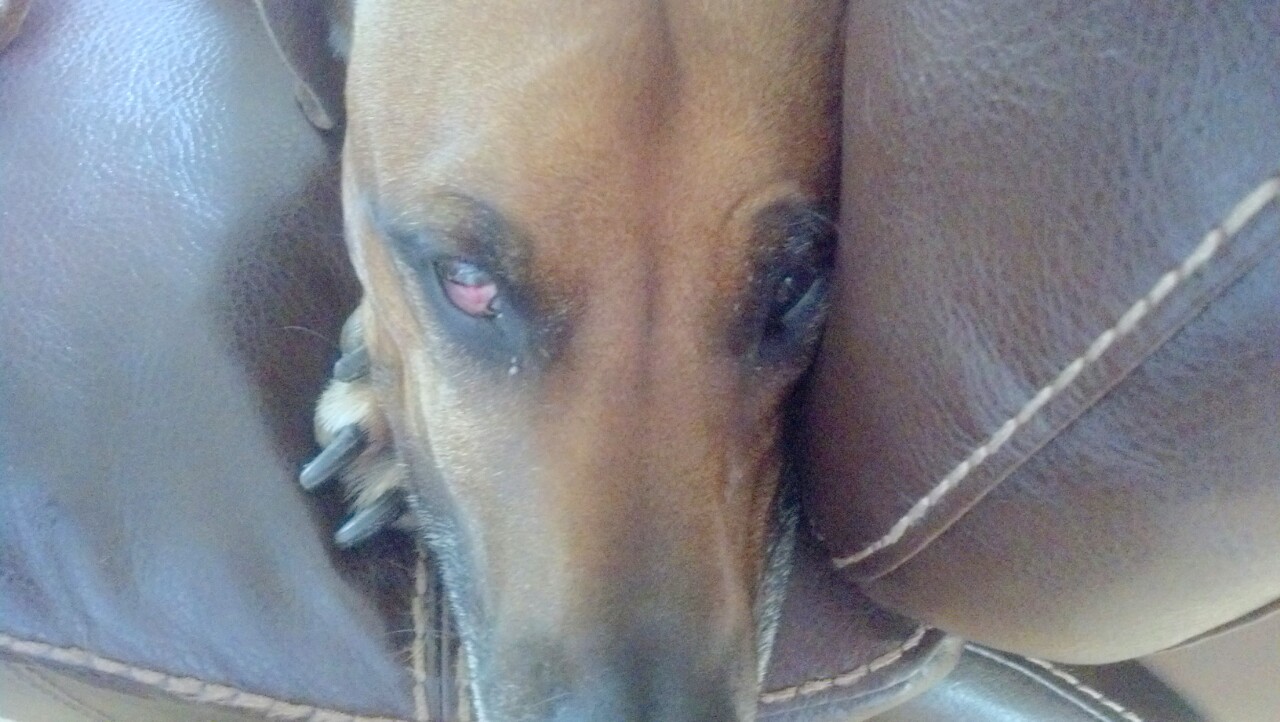
Yesterday, I was finally going to write an exciting update about my strength returning, my one good night’s sleep, and the lovely sunny day, but then this happened: I decided to throw the ball for the dogs for the first time since March. They have been starved for Mama play time, so I reasoned a few throws were my first choice over stretches or walking laps around the garden.

One would think that in my sickly state these throws would be pathetically weak, but I’m using a Chuck-it and an extra large squeaker ball and I’m giving it my all because I know I only have a few throws in me. But this Chuck-it is huge and we don’t have enough space and it is always tricky to get a decent lob. Well, my first attempt, flung with all my effort, drilled directly down in front of me instead of in a nice arch away from me… and bore straight into my big beautiful brown-eyed baby’s eye.

IMG_20130510_164342

This dog doesn’t cry or yelp ever. He injured his back and never made a peep, he just shivered and drooled and couldn’t walk. But the tennis ball today made him cry out and then bolt and kind of run around confused, tail tucked, not knowing where to go. When I got close to him, all I saw was red inside his eye orbit. It looked like his eyeball had been driven back into his head or flipped backwards or something. I had the house locked up, his leash on, my shoes on, my car keys in my hand and my husband on the phone in seconds. I said, “I’m going to the vet. My phone is dead. I need you to call and make sure someone can see him now.” My husband said, “Do you have the strength to do that?” I stopped and sat down on the front steps. I hadn’t even thought about whether I could manage. It wasn’t until I then-when I became still- that I felt the adrenalin like a tidal wave through my body. My legs were jelly, my hands were shaking. I glanced at my heart rate monitor: 125. “I’ll find the strength,” I said. But as I looked at my dog, I realised the red I saw in his eye socket was the inner lid – it’d been completely covering the eyeball and the effect was gruesome. Now that it had retracted halfway and I could see his pretty brown iris, I calmed. The vet could wait until my husband got home.

As I write this, the world is spinning. I haven’t had acute emergency-type stress in my life (luckily) in so long and the feeling is alien. I was mowed over by a speeding epinephrine train and I realised four things:

1. I would be able to handle an emergency. I would be able to mine down deep into my cells for the resources necessary to fight off danger or rescue my loved ones or whatever might crop up… The question is what would (will) the physical ramifications be in the days that follow.

2. I lived with a chronic case of that stress response for YEARS in my job. The feeling was all too familiar. I used to never turn off. There was always a crisis, always a problem, always a fire to be put out (figuratively, not actually, thankfully). And, when there wasn’t an immediate concern, I was looking for one that hadn’t been discovered yet, so I wouldn’t be blindsided. It was a constant stomach queaze, the dull adrenal hum of my sympathetic nervous system stuck in hyper-vigilance, anticipating the next restaurant catastrophe.

3. I, myself, created a lot of that intense stress by being a controlling perfectionist who holds herself to unreachable standards and unsustainable responsibilities. And I still do. It takes work to not blame yourself for getting sick and it takes practice to let yourself off the hook for not getting better. It takes restraint to not take care of the house and it takes discipline to not forge ahead with the life you always wanted. And I try every day to forgive myself for not being the employee, friend, sister, daughter, wife I want to be.

4. I miss it. I miss crisis management and learning how to fix a problem and finding out how to do it better in the future. I miss being an honest adviser, without judgment. I miss jumping into action, making mistakes, figuring it out. I miss being the one that doesn’t need help ~ being the rock and the confidant and the reality check for those I love. I’m kind of sick of calm, quiet, peaceful boredom. I thrive on excitement and stress ~ as long as it is a positive atmosphere and a supportive team with a for-the-greater-good outcome. I knew I should have been an emergency room doctor.

Gratitude for the day: no orbital fracture or scratched cornea or dislodged eyeball. Just some pain and spooked tail-tucking. My pup is okay. But the sunny days are over for a while.

bowie1

Title Credit

Tomorrow is International M.E. Awareness Day.

Tomorrow is International M.E. Awareness Day. There are many events happening around the world, both online and in person. You can google your area to see if there is anything going on, but what I ask is something simple:

Please make an effort this month to talk about this disease. Look for opportunities to raise awareness. Don’t worry about being a “downer” or bringing up an awkward, depressing subject. Let people know that there is an illness that stops life in its tracks and has no approved drug treatments and very little funding for research. Explain that this has nothing to do with laziness, depression, tiredness or burn-out. Explain that there are test abnormalities, but doctors aren’t taught about the (possible/probable) etiologies of this disease so most do not recognise it and certainly don’t know what to test for or how to treat it. Make it known that patients languish in their homes ~ or, more likely, a family member’s home ~ are passed from dismissive specialist to thieving charlatan and back again, use up all their resources, and usually reach a point where they are trying to just survive because it is too exhausting to research treatments and search for medical help. Warn people that ME is often accompanied by crippling neurological issues, autonomic dysfunction, new allergies and multiple chemical sensitivity (MCS), postural orthostatic tachycardia syndrome (POTS), chronic migraines, irritable bowel syndrome (IBS), fibromyalgia (FM), mast cell problems (MCAD), sleep dysfunction and, of course, the depression and anxiety that would be hard to avoid with a diagnosis like this. These are all debilitating conditions in their own right, so drawing awareness to them is just as valuable.

As with many awareness campaigns, ribbons are worn to show support – blue for ME/CFS, purple for FM, and green for MCS. What I like about this is, it might bring up the conversation. Most people recognise the pink ribbon representing breast cancer awareness or the yellow Livestrong wristband which supports cancer survivors, but perhaps you will encounter someone who asks, “What does the blue ribbon stand for?” And then you can launch into your educational lecture. 🙂

meribbon

A few things going on around the world:

Niagara Falls will be illuminated in blue tomorrow, May 12th, from 9:45-10:00pm EST to raise awareness to M.E. From 10:15-10:30pm EST the falls will be purple for fibromyalgia (FM) and from 11:00-11:15pm EST the falls will be green to draw attention to multiple chemical sensitivity (MCS). You can watch it on their live webcam. Or try: http://www.earthcam.com/canada/niagarafalls/

In London, there is the “All Fall Down for M.E.” protest outside the Houses of Parliament at the Old Palace Yard.

londonME

In Victoria, Australia at Melbourne University, there is an ME/CFS Educational Fun Run.

forME

Bob Miller is skydiving to promote ME research in Lodi, California.

The Irish ME/CFS Association is hosting four talks by Dr. Ros Vallings from New Zealand next week.

There are  five screenings of Voices from the Shadows across three continents in May.

Read this article by Mark at Phoenix Rising to get all the details about these events and many more.

Finally, consider writing to your local paper to raise awareness. Read this post by the ME/CFS Self-help Guru for inspiration.

Thank you to everyone in my life that has talked about this baffling illness, raising awareness one person at a time. Thanks to my father for talking to his staff about this disease and to my mother for talking to her dog park friends about it and to Z. and E. for explaining my situation to other people I know and to my husband for constantly making excuses for my absence, trying to educate others on what is going on and raging at medical professionals’ and society’s ignorance, allowing me to be angry by proxy since I don’t have the energy for it.

MEawareness

It’s Cinco de Mayo and I’m not stressed out.

The biggest day of the year for the restaurant company for which I used to work is Cinco de Mayo. When I was a server, it was a gruelling 12-hour, non-stop day during which I would take about 50 times the number of steps I do now in a 24-hour period. The restaurant was new, busy and understaffed. It was exhausting and exhilarating, great money and unforgettable camaraderie. When I was a general manager, it was more stressful and the tips were replaced by a sense of accomplishment. As a regional manager, the amount of work rivaled that of a new restaurant opening. I tried to be the conductor and the first violin at once, as well as the advertising, PR and marketing director. We planned for months in advance: budgets, entertainment, products, staffing… Once I was the COO, things were easier. I oversaw the managers’ work and didn’t have to be there late into the night. Today is the first May 5th since 2003 that I haven’t been focused on festivities and maximizing sales. Ten years. Although, I desperately miss working, I will celebrate this relaxing May Sunday as a silver lining to my situation.

what-americans-think-cinco-de-mayo-is

Try something different. Surrender.

After over a month it occurred to me that maybe just maybe this downturn has been caused by the break from my cpap. I guess, if I’m honest with myself, I didn’t quite believe my apnea was a problem. I sleep through my brain “waking up” 49 times an hour, but I don’t sleep through the cpap mask waking me up 20 times a night, so my subjective view of my sleep is that it is worse when I wear my cpap. What I know for sure is, my symptoms wax and wane in direct relation to how well I sleep. Although I know my ME/CFS was caused by viruses and the flu shot taking advantage of an extremely stressed and depleted body, I sometimes wonder, if I’d slept well my whole life and known about the apnea sooner, could I have avoided this illness?

When I went downhill in April, I reversed any changes I had made in the weeks before: I went back to Now Foods vitamin B2 and alpha lipoic acid, since I had recently changed brands. I stopped the Seriphos supplement, I stopped the Chinese herbs, I stopped driving anywhere, I stopped walking and doing stretches, I stopped taking baths since they raised my heart rate so much. But nothing has been working. I have to try something different. Since my health insurance is taking its sweet time approving my apnea dental device (shocker), it’s going to take well over a month to have it made. Verdict: back to the cpap. Keep your fingers crossed that this makes a difference.

My other plan is to surrender to this new low. Somebody on an ME/CFS forum recently said, “We may have lost everything in our lives, but WE HAVEN’T LOST OUR LIVES.” It stayed with me. I’ve spent 1.5 years fighting, investigating, grieving, pleading, hoping, wailing, warring… Again, time to try something different.

I’m sorry to throw quotes at you, but this, too, has stuck with me for weeks and it is my current inspiration:

Very little grows on jagged rock.
Be ground.  Be crumbled.
So wild flowers will come up
Where you are.

You have been stony for too many years.
Try something different.  Surrender.

~ Rumi