Winter of Disjointedness

I haven’t written an update in over 7 months, which boggles my mind. It was the same amount of time between my two previous blog entries, too, so I’m not doing a very good job of keeping my friends and family up to date, but I find the speed at which our lives zoom by very unnerving.

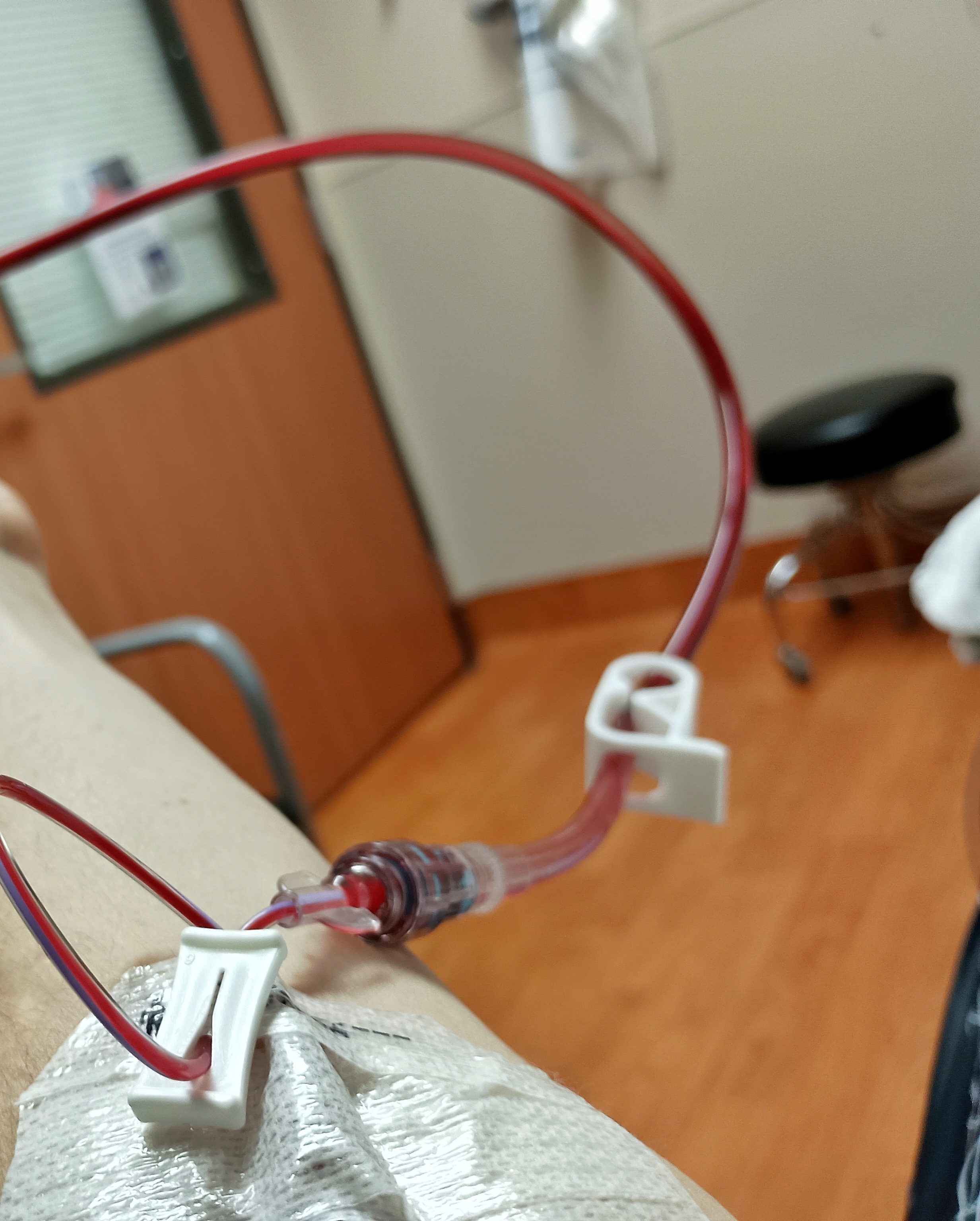
Yesterday, my husband and I were marveling that it had been over 2 years since I stopped doing weekly immunoglobulin infusions and IV fluids. For so long, it was our routine, dictating the days he worked, the days we cleaned, what I ate, when I showered… Then we stopped and lapsed into a no-structure schedule and I’ve definitely gone downhill since then, but can I blame the lack of IVIG? I don’t know. I guess partly. 

It has been incredibly beneficial to me to track the big changes over the past 12 years – it’s helpful for my mother, too, who needs to take notes to remember the big diagnoses and events, let alone the nuances of ever-changing chronic conditions. 

And that – “ever-changing” – is my biggest hurdle. It’s hard to call my illness chronic when it seems to jump from one new acute problem to another, the blindsiding surprises causing a constant low-level wary vigilance that takes an incredibly heavy toll on us both, as we try to anticipate any crisis and create contingency plans for every situation.

Looking back on the last 7 months, two big things stand out – one good, one bad.

The good is that I finally figured out, after many months of scary bowel, blood pressure and heart issues that were truly life-altering for both of us (I couldn’t be left alone in the mornings), that I had developed reactions to Miralax (polyethylene glycol, like Macrogol), which had been my safe bowel medication for years (I’ve failed all of the prescriptions I’ve tried thus far).

It took an elimination of almost every single other thing I ingest to figure it out. I was scared to eat or drink anything, not knowing if, many hours later, all hell would break loose and cause hemodynamic instability that needed medical attention. But it was the Miralax, which I would take halfway through each night’s sleep. 

Since stopping Miralax, I have had fewer than 5 serious bowel episodes that caused pelvic floor spasms. They had been happening daily and I can’t overstate the difference in my quality of life without this constant threat and fear. 

My first endocrinologist told me: “With new symptoms, always look first at the medications you take.” Over and over, I have failed to remember this advice, like a few years ago when I was in an extreme hyperthyroid state – breathless, palpitations, not sleeping, thinking I’d developed anxiety because of the “beehive in my chest” – and it took 3 months before it dawned on me that it was from increasing my thyroid medication. Those symptoms were gone immediately after I stopped taking (temporarily) those hormones.

So, take heed, friends: never assume a medication is benign just because you’ve taken it for ages with no issues.

The bad standout thing from the last 7 months is a massive increase in EDS instability problems. I have a few areas of my body that have been “going out” repeatedly for years, but usually resolve after a few days or weeks: my neck, right clavicle, right thumb and one spot in my thoracic spine. But, back in December, I developed back-hip-SI joint instability that caused repeated injuries with normal, innocuous movements, like sitting up in bed.

I got hip x-rays and a lumbar MRI, which didn’t show the herniated disc that the doctor suspected. I started physical therapy, but a sneeze one night in February, and daring to sit on the loo the next morning caused an injury that landed me in the emergency room.

Something ripped (my physical therapist thinks a ligament or tendon attached to my sacrum) and I couldn’t get off the floor and I couldn’t empty my bladder.

The EMT that came to my house was married to a woman with EDS and he understood everything that was happening to me, which was incredibly reassuring, as the back pain in that moment made it difficult to explain that no “event” or accident had caused the injury and that my blood pressure is normally this low and that I didn’t want any medications because of reactions and please be extra careful when transferring me from clamshell to gurney to bed etc.

In the ER, I wound up having to create a huge fuss, begging for/demanding a catheter because “I am going to jam this pen into my abdomen to drain my bladder.” The pain eclipsed anything I’ve felt before. Bless the EMTs again – they could have left me in the hospital hallway, but they insisted I get a room before they left. It took 2 nurses way too long to get a foley catheter in, while holding me down with my legs splayed back, making my hip/back injury much worse, but, eventually they were able to drain 1200 ml of urine, noting that it is normal to feel the need to pee with about 150-200 ml.

The rest of the hospital visit was a debacle. They ordered another, redundant lumbar MRI, even though I repeatedly asked for a hip/SI joint MRI. They ordered a kidney CT scan, even though I asked for an ultrasound (so much radiation in my life!). They didn’t secure the bladder catheter to my leg and the balloon got pulled out accidentally, which is one of the worst pains I’ve ever felt. They told me my bloodwork looked fine, even though my potassium was too low. They couldn’t get my IV line to stop filling with blood (the doctor actually came in, said, “that’s weird,” clamped it off and left (?!), so I unclamped it and got medical tape out of my bag to secure it myself in a way that allowed the saline to flow). And they gave me fentanyl, which didn’t touch the back pain, but caused one of the worst migraines of my life that went on for days and I thought I might have to go back to the ER to break that pain!
But, worst of all, I couldn’t be in a seated position in the week afterwards and bearing down slightly (which I have to do even to pass gas and urine) flared the pain in my flank, so I couldn’t do my daily enemas, which meant I couldn’t eat. It became very obvious that something like this – a different structural issue – would probably be the thing that pushes me into bowel surgery. 

[An aside: I understand that this downhill progression in mobility and upward trajectory in pain is probably due to my tethered spinal cord, for which I have so far refused surgery, but, no, I’m still not convinced that that operation would make things better. I will write about this some other time.]

During this time, I had an urgent appointment with Dr. McDreamy, my colorectal surgeon (who really is dreamy) to figure out next steps in case the injury remained bad enough that I couldn’t eat/poop normally (ha – as in, my “normal”) for an extended period of time. He said that he would be available whenever I was ready and we could do a colostomy bag. Music to my ears. The most reassuring discussion I’ve ever had with a doctor. He said I could try botox in my anal sphincter and a sacral nerve stimulator first, if I wanted (though, they won’t fix my prolapse issues, so they are not long-term answers). 

I haven’t made those appointments yet. As usual, I don’t want to rock this shitty, broken, leaky boat in case it makes things even worse. I’ve been concentrating on the most pressing concern, which is trying to heal this injury, but it’s discouragingly stubborn and I have no medications to help, aside from CBD balm and lidocaine patches. It’s a moving target, from left hip to SI joint to lumbar spine to thoracic paraspinal muscles and back again.

I have to be aware of every change in position: I am wearing an SI belt and lumbar brace all day, but sitting, turning, reaching, and bending can all cause re-injury. I have 4 physical therapists(!) and I’m doing daily exercises, but they are tiny, basic isometric movements that always cause worsening pain, so it’s slow-going.

I’m disabled to the point that I haven’t gone for a scooter dog walk in 8 weeks and I’ve also had massively increased exhaustion and weakness in the last month, so everything feels impossible. Getting out of the house with Penny is the only thing that keeps me sane and this has really taken a toll. But, even if my normal energy returns, my big mobility scooter with good suspension is just too jostley on a body held together with jello and rebar. 

In a post 15 months ago, I said my plan of action consisted of:

  • Getting calories in and out (I’m doing an adequate job of calories, but not nutrition. I’m eating about a third of my protein needs and not nearly enough vegetables for my vitamin requirements)
  • Keep trying bowel medications (I’m currently managing with only Mag O7)
  • Pelvic floor physical therapy (I’m now in regular and counterstrain PT)
  • Get a “small bowel follow through” study (didn’t do)
  • Get a mesenteric CT angiogram (didn’t do)
  • Talk to my surgeon about a stoma (done!)
  • Trial a fentanyl patch (done!)

My updated plan is:

  • Better nutrition
  • Get immunoglobulin infusions back
  • Trial painkillers, muscle relaxants, bowel meds and more
  • Religiously do PT exercises
  • Get a small bowel follow through
  • Try anal sphincter botox
  • Come to terms with the fact that I can’t put off bowel and spinal surgery forever. And we’re not getting any younger.
Uncharted Waters

I’ve reached a new physical low and I don’t have any idea of the best direction to go from here. When it comes to my health, I don’t do well emotionally without a plan of action. I can only rest easy when I have prepared for all eventualities to the best of my ability, whether it is going for a drive in the car or thinking about major surgery. As an example, I made a will when I was 37 and, in 2011, I asked my boyfriend of 13 years to marry me so he could legally speak for me if I couldn’t speak for myself. That’s a romantic proposal.

But I’m currently blinded by pain, fear and exhaustion from constant interrupted sleep. I’ve been working so hard this past year to get the appropriate testing of my GI tract, do the hail mary treatments and line up willing surgeons for the operation that is undoubtedly needed, but… a decade into this shite, I am finally at that stage where doctors look at my records and show me the door.

One doctor said right off the bat: “Do you know what scares surgeons the most? EDS [Ehlers-Danlos Syndrome]. Do you know what scares us the second most? MCAS [Mast Cell Activation Syndrome].” She sent me on my way, unwilling to even discuss what was happening anatomically.

I had another surgeon walk into the exam room and, without any greeting whatsoever and without even looking at me, she said, “Well, you certainly are obsessed with your bowels, aren’t you?” Immediately after that, she asked for the name of my therapist. There was more and worse derogatory interactions with her, but I’d like to not get riled up tonight. My great therapist said, “You encountered one of life’s assholes, this one just happened to be a doctor.”

I’ve decided any surgeon who is a) compassionate and b) willing to help people with connective tissue disorders and idiopathic anaphylactic reactions is a bloody hero. I had no idea I would become a medical pariah. 

There was a time when I was trying to fix my immune deficiency, my hypotension, my hypothyroidism, my chronic migraines, flu-like symptoms, reactivity etc… It’s all still there and I’d give anything to “just” be dealing with those. I’d have some semblance of life; I’d not be in crisis every day. Sick, yes, but not crisis. I was once chronically, predictably, stably ill and it feels a bit perverse to long for that life again.

Five years ago, I started to have intermittent pelvic floor spasms. Some were very obviously bowel spasms and some were the muscles/ligaments of the entire pelvic floor. The latter were more severe and often triggered a vasovagal collapse where my blood pressure and heart rate would plummet and my husband would call the paramedics. I stopped a lot of things to try to control these. I stopped having periods, I stopped taking stimulant laxatives, I stopped holding my pee, I stopped eating “FODMAP” foods that can generate gas, I stopped having sex.

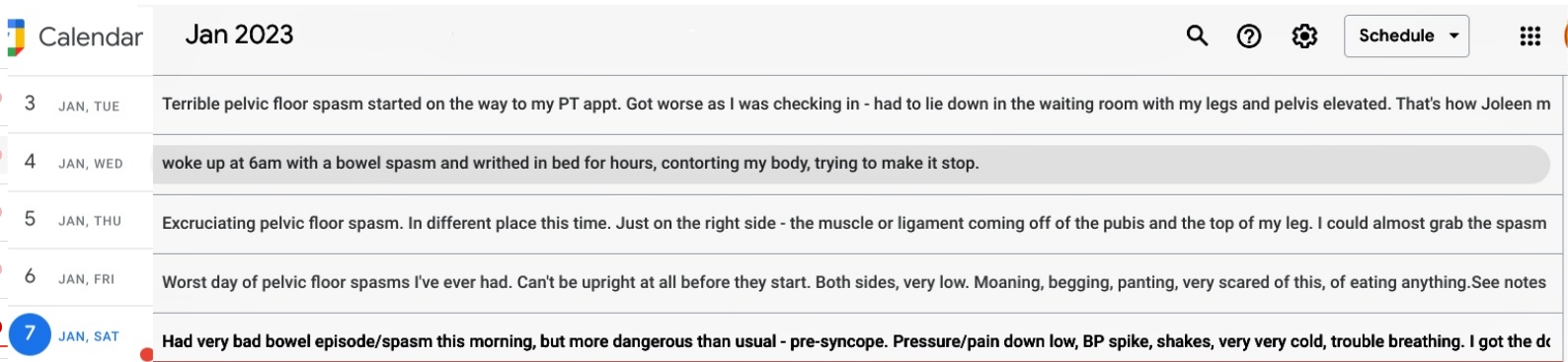
A year ago, the spasms started to escalate. I had one single episode in January, 2022 and, this week, I have had at least one a day, six days in a row. They are SEVERE. I never use that word lightly. They are agony and I never know how long they will last and whether they will trigger a cascade into hemodynamic instability or loss of consciousness. 

screenshot of my calendar this week

The spasms usually start in the mornings when I stand up (or sometimes just sit up in bed) and my intestines drop towards the ground, along with my bladder and uterus (which have also fallen from their normal positions). The weight and pressure this causes on my pelvic floor kicks off a spasm and it is greatly exacerbated by stool or gas in my colon, so eating anything has become scary. Terrifying, actually. Even drinking causes problems — I recently realised that my electrolyte water (TriOral rehydration solution), which I’ve been drinking day and night for two years, was causing a lot of gas production.

Gas causes more issues than anything because it gets trapped in the folds and herniations and the pressure increases to unbearable levels. The pain is blinding. And by “gas,” I really mean air because there is absolutely no smell at all. It is as if someone inserted a hose into my transverse colon and pumped it up. I’ve been eating a very limited diet for years – there really is nothing more I can cut out to try to manage gas production. It’s there even if I fast and it’s made worse by the medications I have to take for constipation like Miralax, Linzess and magnesium oxide. It’s there because I probably have SIBO, too (small intestinal bacterial overgrowth — I’ve treated it many times, but I’m not sure if it’s worked).

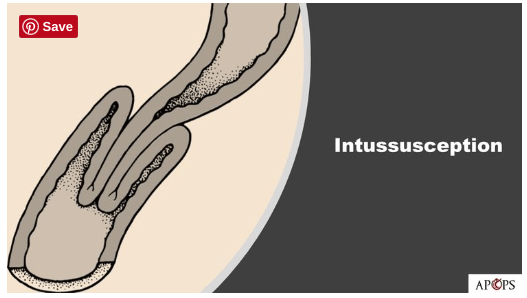
My small bowel is “lying on the bottom of your pelvic floor, like a hose curled in the bottom of a bucket,” one surgeon told me. “Nothing is connected to the sacrum anymore — you have complete internal rectal prolapse with intussusception of the rectosigmoid.” He drew a picture of this “intussusception” – the intestine looks like a sleeve telescoping into itself when you pull your arm out. 

My umbrella diagnosis is visceroptosis – abdominal organs falling and prolapsing out of their normal positions – but there are different names depending on which organ has the issue. The ones I have are:

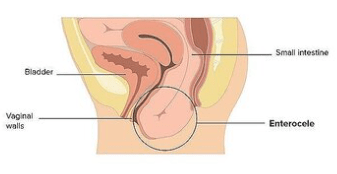
Enterocele: where the small intestine falls between the vaginal wall and rectum (which should be fused, but, in my case, are separated).

Sigmoidocele: essentially the same as an enterocele, only the sigmoid colon has dropped.

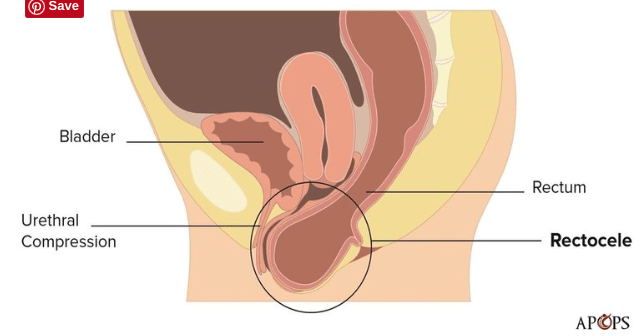
Rectocele: the rectum herniates forward and into the vaginal wall.

Cystocele: bladder falls. 

Uterine prolapse: uterus falls.

Perineal descent: perineum bulges downward. 

Intussusception: telescoping intestine. 

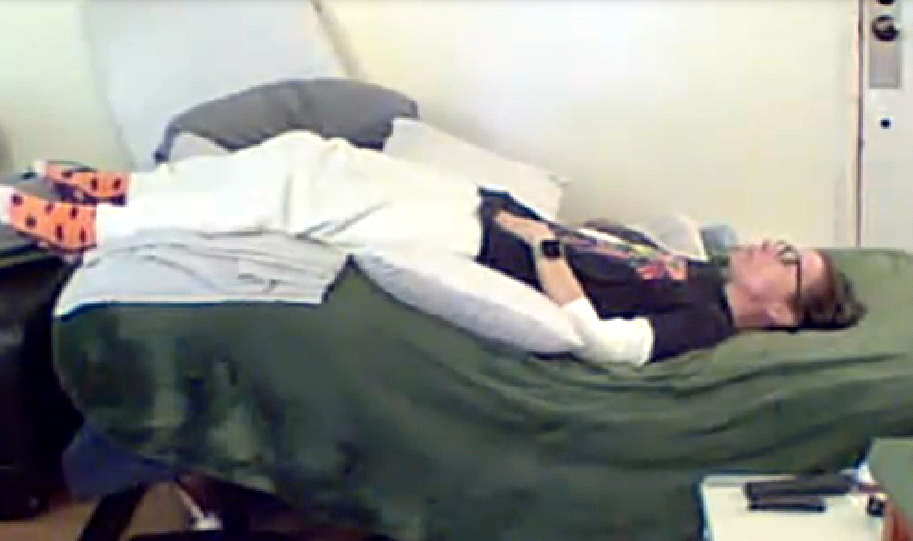
The two most profound issues I have on the MRIs are the enterocele and rectocele, above. So, as you can imagine, with both of those bagged-out intestines holding onto poop and gas, prolapsed into the same low-down space, as well as my uterus and bladder sagging, it is an unbelievable amount of pressure on my pelvic floor. The only thing that has helped marginally is lying on an adjustable bed with my head as low as possible and my legs elevated, which allows gravity to shift my intestines back towards my chest. I do this over and over throughout the day to reverse the downward pull – after standing in the kitchen, after sitting at the table or on the toilet. But it doesn’t last long and just moves the pressure under my diaphragm.

Recently, though, things have escalated. Cramps wake me up all night long and, during the day, I can hardly be upright without my pelvic floor going into a spasm. I quickly get on the floor, put cushions under my bum and moan, pant, cry, try to focus all of my attention on relaxing those muscles and easing the weight on the ligaments, while begging the universe to make it stop and vowing to never let anything pass my lips again. I’m hungry all the time.

I can’t keep doing this every day. I don’t want surgery, but I can’t avoid it. I don’t want mesh implanted in my abdomen (my immunologist says absolutely no mesh in someone with a mast cell disease), but I’m told the only other option is a colostomy bag. I’m told whatever I do will probably fail (even the bag) because I will still have slow-transit constipation and shitty connective tissue. I’m told that the spasms might not stop. That thought is very overwhelming. The spasms are more life-altering that anything else. What would the future look like trying to avoid them? Pooping into a bag, but nil by mouth? IV hydration and parenteral nutrition? I need doctors to think outside the box about how to stop the symptom escalation. Botox? Prolotherapy? Nerve stimulators? Nerve blocks? Am I going to have to live mostly on my back to stop my organs from falling?

There are Facebook support groups for everything you can think of, but not for visceroptosis caused by EDS. I’ve met two people in a similar boat. (One of them shared photos of herself in the morning and at night showing how her displaced intestines caused her abdomen to balloon out over the course of the day. I did the same thing yesterday and it is striking, but, although I share everything about myself here, I’m not sure I want to post photos of myself in my knickers. Sorry to disappoint.)

There are no doctors who really understand this particular problem and there is an incredible paucity of studies. A prolapse specialist said to me: “I wouldn’t refer you to any of the colorectal surgeons I know. They really only do routine tumor excisions or coloectomies for things like bowel cancer.”

Oh. I see. What an education I’m getting! Silly me thought that any colorectal surgeon could fix this. My problems are “higher up,” not a “simple” rectocele repair. My issues are from connective tissue laxity, not from pregnancy trauma. Not only do most colorectal surgeons not have the expertise and experience, most wouldn’t take me on, anyway, because they and their hospitals like success – they don’t want to take chances on patients with high rates of complications and surgical failures. These are uncharted waters.

My only plan of action right now is:

  • continue doing everything I can to get calories in and out.
  • keep trying and retrying bowel medications.
  • continue pelvic floor physical therapy (which feels useless – breathing exercises, bowel massages, visualisation).
  • get a “small bowel follow through” study (which is proving to be complicated – shocker! – because they don’t usually do upright x-rays and they don’t have any barium drinks that look okay for me to ingest).
  • get a mesenteric CT angiogram (which I’ve been putting off for a few years because I had a small reaction to the IV contrast last time and I’m nervous it’ll be a bigger reaction this time).
  • talk to my surgeon about a stoma (for a colostomy bag) since he won’t entertain the notion of a repair surgery without mesh.
  • trial a fentanyl patch in-office with my immunologist and then other medications to develop a post-op painkiller plan (how on earth do I get the nerve to do this??).
  • do I continue looking for other surgeons who have experience with these more complicated, “higher up” repairs and who won’t use mesh?? It’s exhausting and I really don’t think that doctor exists.

But none of that feels possible when I’m so depleted. My husband had a total knee replacement surgery a few weeks ago and the extra walking, driving and chores I was doing made it very evident that my tethered spinal cord is a major player, even though I don’t want to face it. When I’m pushed outside of my energy envelope and normal step count, I have great difficulty walking. I’m hoping now that he has turned a corner with his recovery, I’ll be able to gain some ground and see a clearer path forward.

Pandemic MRI Tips

Wednesday night, I spent 3 hours in an MRI tube getting brutal imaging done of my brain and cervical spine. In general, I actually enjoy MRIs — I find them soothing and almost always fall asleep (the keys to making it relaxing are really good earplugs and eye shades that you never take off) — but the majority of the scans I had done the other night were in extreme flexion and extension of my neck, so it was very uncomfortable. I didn’t get home until 10:30pm.

I’ve already seen the radiology reports and they’re not great, unfortunately. I hoped things would be stable, but there are further degenerative changes to my cervical vertebrae with herniations impacting my spinal cord. More concerning to me is the lack of CSF flow in my cerebellum (posterior foramen magnum) is still noted (was first seen in a previous CINE MRI two years ago) and now there also is restricted CSF flow in the cerebral aqueduct. This is probably being caused by low-lying cerebellar tonsils, which is probably being caused by my tethered spinal cord pulling down on my brain stem. It’s overwhelming. But more on all that some other time.

I had some thoughts about managing these sorts of tests, especially with covid concerns. I’m unvaccinated (inching closer and closer every day to taking that gamble, though), so it was especially nerve-wracking as I pictured Delta shedding off the MRI techs in thick clouds (during those 3 hours, they probably spent a total of about 20 minutes standing a foot or less from my face as they had to add and remove bolsters and adjust me in different ways. They were both wearing very flimsy surgical masks, like limp paper towels. No well-fitting N95s here. Shudder).

I should have asked the techs to back up because they really didn’t need to be so close, but… well, it’s complicated. It comes down to the really embarrassing fact that I think I’m trying to be liked. A people pleaser. I expend an enormous amount of energy during appointments because I always wind up chatting and making jokes and acting normally due to adrenaline surges. And, in this case, because I am so bloody complicated, I tried to be easy and low-maintenance when I was in the hospital.

The lead tech went to unbelievable lengths to help get these MRIs approved and executed properly. He talked to my neurologist, he got the appointment moved to the Northwest campus, he emailed me updates, he let me fax the orders and doctor’s notes to him since they were having such a hard time getting my doctor’s clinic to do it. He left his shift at the UW Medical Center and drove across town to do my scans (at night) to make sure they were done properly (which was good because the other tech had never seen anything like them — we did a dynamic motion series, which involved moving my neck/head fractionally from full flexion into full extension, stopping 16 times to hold still for an image to be taken).

The imaging orders took over a month to be written properly and get approved (one of the schedulers was almost in tears talking with me. She said, “I told my supervisor: ‘We need to get this done! Our motto is patients first. Help this woman!’ I was shaking!”), so the upshot is, I didn’t want to cause waves or be a pain in the ass by asking him to step way back. Really hope that decision doesn’t give me covid. But I’d already told him my immune system was compromised and I was unvaccinated, so I guess he must have been pretty confident that he was not asymptomatically infected. I’m feeling weak-willed, though. I advocate for myself at every turn and then I don’t make sure we’re distanced? Ridiculous.

Back to the reason for this post:

Oh, wait! I had the craziest thing happen. The tech stopped the imaging at one point and said, “There’s something metallic in your armpit area. Can you see what it is?” HUH?

I have my eyeshades on, so I can’t see and I’m fishing around in my armpit and I find a little metal stick. “What is this??”

The tech has come into the room and he says, “It’s a bobby pin!”

“But I don’t wear bobby pins, I swear!”

And he says: “Oh, you know what, there’s a chest pocket inside the scrubs we gave you because they’re reversible, I bet it came through the laundry.” WTF?

Sure enough, there’s a little pocket and I guess the bobby pin was sucked out of it and into the armpit of the scrubs by the giant MRI magnet.

And then what do I do? I drop it, thinking it’ll just fall on my stomach. Not sure why I did that, but I hear him say, “OH NO, DON’T” and, in a flash, the bobby pin has bulleted straight into my face. It stuck to my chin by one end, the length of it horizontal to the floor, like a teeny arrow. WTAF?!

It didn’t hurt because I had a mask on, which cushioned it, but I had no idea everything was so magnetized when the machine wasn’t taking images. I couldn’t help thinking: What if my eye shades were off and it had torpedoed into my eyeball?! Jeesh. Luckily, we all got to laugh about it.

Ok: 

Here are my top tips for getting an MRI during a pandemic when you’re unvaccinated and your immune and autonomic nervous systems are haywire:

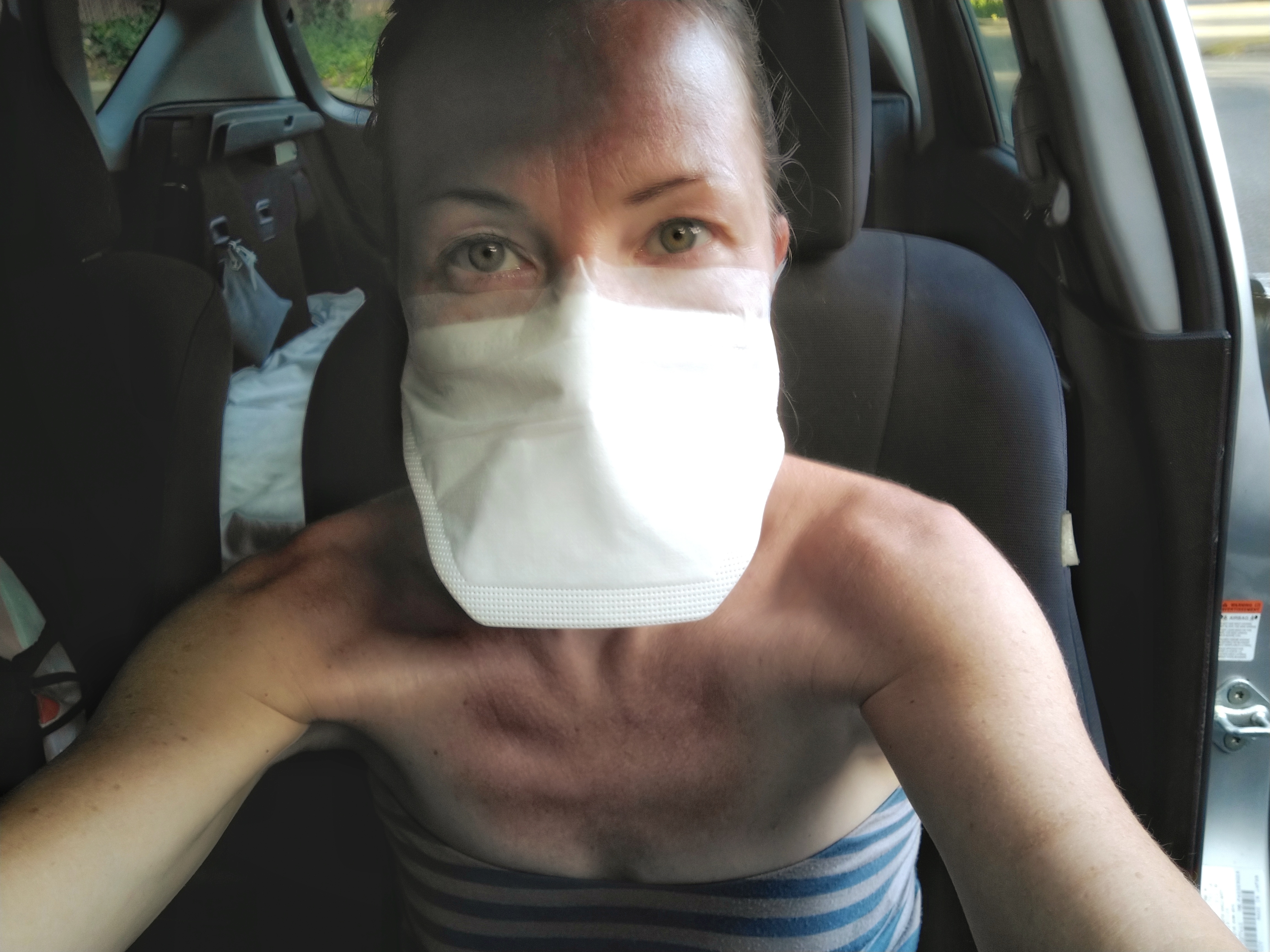
* You can’t have metal in an MRI machine, which means removing the nose piece from most masks. I didn’t want to wear my Cambridge or Airinum masks because I wanted something disposable (albeit an N95 rather than the equivalent of an N99 in the case of the cloth masks). I taped the mask all around my face with paper tape because, without the nose piece, it didn’t fit well. The paper tape was a bitch to get off and stretched my skin off my face alarmingly, but, hey, better than covid. I had a face shield, but didn’t wind up wearing it since I had to take it off as soon I got in there. I also put a surgical mask over the N95, which was undoubtedly useless, but I felt better “double masking.” These N95s are legit (I called the company, Kimberly-Clark and they gave me the Amazon link) and even though the duck bills look silly, they are much easier to breathe in. After being in the MRI tube for so long, I was really happy not to have one of my heavier reusable masks on. 

* These are the other precaution suggestions I’ve collected over the past year: Some ME doctor (Klimas?) said xylitol nasal sprays can help in a protective sense before possible exposure and saline nasal rinses might help afterwards. I also bought Nasal Guard (a gel that you put around your nostrils and mouth that might catch allergens/germs before they enter your airways) and Nasal Screens (little sticky “filters” that cover your nostrils). You could also use WoodyKnows filters, but I can’t seem to get them to stay in my nose. So, during my MRI, underneath the taped-on paper N95 mask, I used the nasal screens and gel.

* Make sure to bring good earplugs. They have some for patients, but a) who wants to use the hospital ones? and b) they are never good enough. I like these chunky foam ones that expand to totally seal my ear canals. They don’t cost much for a huge box (I wear them to sleep) and I cut the ends off of them, so it’s not sore sleeping on my sides. Make sure you know how to insert earplugs. I literally needed a lesson: roll them in between your fingers until they’re as skinny as possible and then put them into your ear (you can pull down on your earlobes to get them further in) and then gently press the outside to keep them in place as they expand. These changed my sleeping life. After hours, the pressure inside the ear canal can get sore, but your ear toughens up pretty quickly if you stick with it. Anyway, they are a necessity in an MRI because the headphones do sweet FA. Plus, in my case, I couldn’t wear the headphones in any position except neutral. 

* I usually bring my own eye shades, but because of covid, I used theirs, which are in a plastic bag and disposable. They smell new-plasticy/nylony, but, with my mask on, I didn’t notice. Like I said, put them on before you’re moved into the MRI tube and then DON’T TAKE THEM OFF. You don’t want to see how close the antenna (face cage) or the walls of the tube are to your nose. It breaks the “I’m fine” spell and can freak you out. MRI machines these days are pretty roomy and they have cool air blowing, so you really wouldn’t know you’re in a restricted space as long as you don’t look. (Another tip: you can ask them to turn the blowy air up or down.) I had to move the padding under my head and shoulders over and over again for the different positions and my elbows kept hitting the walls of the tube, which is a sure way to break the spell that you’re lying on the beach, just fine. Luckily, I don’t have claustrophobia. For the dynamic scans, the tech asked me to just leave my arms above my head, which was the only time I felt slightly unnerved because it was so cramped (back arched, neck in extension, arms above head, but not too bent because he didn’t want me to touch the tube and create some sort of looped current or some shit. Yikes).

* If you’re getting an MRI, ask for it to be done on a 3T machine, so you have the best quality images and don’t have to redo them.

* If you’re getting a supine cervical MRI ask to add in flexion, extension and rotation, so you (hopefully) don’t have to do an upright MRI (agony), which the tech called “garbage” since they are done with a 0.6 Tesla magnet (most neurosurgeons prefer 1.5T or higher).

* Find out the location of the 3T machine. In my case, I could get them done at a company called CDI, which is right by my house and it’s inside a small imaging clinic versus a hospital (less covid risk). But, it turned out, the 3T machine was in Bellevue (much further away from me) and would involve my husband taking the day off of work and sitting in a lot of traffic etc. I was switched to the University of Washington Medical Center, but the radiology suite is a long walk through a big hospital and would, again, necessitate my husband leaving work (and expose himself to covid risk) because, although I could probably drive there myself and walk to the MRI, I didn’t know how the flexion and extension would hurt my neck or exacerbate my symptoms and there was a chance I wouldn’t be able to walk back to my car and would need a stranger and a strange wheelchair. Or I might not be able to drive myself home and would be forced to get an Uber. Hell no. Ubers were bad before covid.

More importantly, the other location option — UW Northwest — is a few minutes from my house and I already know that the 3T machine is in a quiet building, separated from the hospital and that the MRI room is literally a few steps down from disabled parking, which is always empty. It’s a small suite and it’s always been just me and the tech every time I’ve been there. Last time I had an MRI at the big UW Medical Center, there were dozens of people teeming around and I had to wait for over two hours because of a backlog of scans. 

* Ask for an appointment on a weekend and/or the first appointment of the day and/or the last appointment of the night to avoid humans.

* After you check in, wait outside, if you can. For those in my area, this is really easy at Northwest Hospital. They just pop their head out the door when they’re ready and I’m right there at my car.

* Wear hardly anything. I left everything I possibly could at home. Jewellery, purse etc. I only brought my phone, hand sanitizer and my emergency MCAS stuff that I bring everywhere. I wore nothing but underwear, a long skirt pulled up to be a “sun dress” and shoes.

* If you are getting any imaging done that involves different positions, bring something for support and bolstering of your skull and neck. I brought a big pile of washcloths from my house so I wouldn’t be using the hospital’s foam wedges. I rolled them under my head and neck to help with the flexion and extension images and under the sides of my face to give support when my head was in rotation.

* Ask the MRI tech to let you know in advance how long each sequence will take and whether you can move and adjust yourself. It can get sore staying so still, but every time you move off of the mid-line, they have to recalibrate the machine with a “scouting series.”

* Pretend you’re in a medical pod and the MRI is healing you. I usually drift off to some sci fi place, imagining all the blerp blerp blerp gramma gramma gramma patel patel patel noises are curing my disease. 

* I bagged the washcloths and my clothes when I got home so I could wash them later and took a shower. I also sprayed alcohol on my shoes and backpack. Oh and I used mouthwash for the first time in a decade and just hoped that I didn’t have some weird reaction to the alcohol/flavourings/colourings (I didn’t).

What I did wrong: I didn’t eat and drink enough before leaving. Everything takes longer than you think it will, it seems, and with a taped-on mask, there was no sneaking a lozenge or anything. I was parched and ravenous and wound up eating dinner at 11:30pm.