Springtime!!

Cherry Blossoms!

Springtime!!
Cherry Blossoms!
Some people in my M.E. Facebook group have been posting photos of their “bad” days to try to raise awareness of the plight of severely affected patients.
This is one of my bad days, which is most days recently (taken after hours of shaking chills and horrible nightmares during a sunny afternoon, with a blood pressure of 76/47 even after pints of salt water and electrolytes).

Some of you have commented on how exhausting/frustrating/crazy this elimination diet process is and I agree! It is incredibly time-consuming considering the research into studies, the searching for recipes, the phone calls to grocery stores, the time my husband spends shopping, menu discussion, and cooking time…! Since none of my diet changes has made me feel any different, it seems like a futile process, but here is what I always keep in mind:
Some people, such as my brother, eat a paleo diet even though they are completely healthy ~ they just want to continue to feel great. Or feel even greater. Some people are diagnosed with a thyroid condition or an autoimmune illness and immediately change the way they eat, trying to ease symptoms or stop the progression of disease. I never even considered doing these things! I had one odd health issue after another and never changed a smidge about the way I eat. The doctors didn’t mention diet, so I didn’t think about it. I didn’t even research the things I was experiencing. This blows my mind more than anything. My time was fully committed to my job, there was no room for anything else. Plus, they were intermittent episodes (I thought) and I was still feeling fine (I thought), so everything was easy to ignore. I had given up alcohol, which, to me, was the ultimate sacrifice ~ do you think I would give up anything else? No way!
One of the best gifts I was given was my OBGYN off-handedly saying, “You should eat some salt if you feel like you are going to collapse.” Uuuuhhh…? Why didn’t I know that? I’d been limiting my salt for years because I thought it contributed to the swelling. Couldn’t just one of the many nurses that have taken my blood pressure over the years mentioned salt to me? They always comment on how low it is and I always let them know I get dizzy. “Try increasing salt.” Just that simple.
The other thing I always keep in mind is my dog, Bowie. When he was young, he developed bumps on his skin. The vet thought it might be a food allergy, so we changed him to a limited-ingredient diet. Over the next year -maybe two- his skin got worse and worse. We changed his shampoo, we washed him more, we washed him less, we gave him supplements, he was put on Benadryl. His coat is a beautiful, deep, glossy brown; he looks like a stallion. But the bumps got bigger, his skin was like braille, and his skin started to have a distinctive infected smell.
Then, one day in the dog park, there was a hand-written sign tacked to a post: “Natural Balance food is killing dogs!” It had some other info on the sign that I can’t remember, but there was nothing online that we could find. Regardless, we paid attention because that’s the brand our dogs ate. And then a miracle: Literally, a few days after we switched their food, we had two puppies back in our house. We didn’t even realise that their happiness and activity level wasn’t normal for them because that’s all we knew for so long. They were DANCING. They were LAUGHING. They were running around like we had just removed their shackles. And then Bowie’s skin made a total turnaround: The bumps and smell disappeared incredibly quickly. We were very grateful, but my heart was broken over the poison we had been feeding them. If anyone had witnessed the change, they would know the radical difference food can make to health.
Lastly, I never want to look back and regret not trying diet changes. One would think that time ticks by slowly when you are sick and housebound, but, it turns out, the years speed by quicker than ever. I don’t want to be 50 or 60 and wish I had tried this in the beginning of my illness.
So, after 3 weeks of eating sort of low-histamine and a month of eating strictly low-histamine, I was not feeling any better. In fact, November and December were probably the worst months I’ve ever had, but I blamed that mostly on repercussions from the tilt table test and IV fluids reaction. I’m sure the stress around a new way of eating and hypoglycemia didn’t help matters, though, so I allowed in some histamine foods (bananas, berries, lemon, some vinegar, all greens, all meat), but I have continued to avoid the biggies (fish, spinach, tomatoes, eggplant, pickled/fermented foods, dried fruit, leftover animal protein). I needed to increase my protein intake to stabilise my blood sugar and started force-feeding myself meat. It was joyless, like taking medication. I am eating this chicken so my blood sugar does not tank in the night… (picture me sitting in bed, eyes closed, slack-jawed chewing a piece of cold, dry meat, grimacing as I swallow).
Around the same time, I eliminated oats ~ the only grain I had never lived without and had, in fact, been eating every day in the form of granola/porridge and oat crackers ~ and that left me desperate for breakfast options that included protein. Beef breakfast patties became a staple. We started investigating all the butchers in our area and my husband talked to all the grocery stores. We figured out when deliveries come in, whether they are fresh or frozen, how long since the date of slaughter, and we buy grass-fed, pastured beef and lamb, organic chicken and turkey, trying to source the healthiest and freshest meat to continue keeping histamine in check. My husband cooks the day we buy meat and then we freeze portions so I have meals at the ready. He still makes beef bone broth and chicken stock, but we cook it in a shorter amount of time and freeze it in silicone ice cube trays and jars. Beef patties for breakfast. Lamb shepard’s pie, portions wrapped in wax paper. Chicken and turkey breasts that can be thrown in soup or chopped on a salad or served with rice pasta and topped with veg and sauce (see FOOD! page for some recipes). Blood sugar crashes became much rarer.

Frozen broth
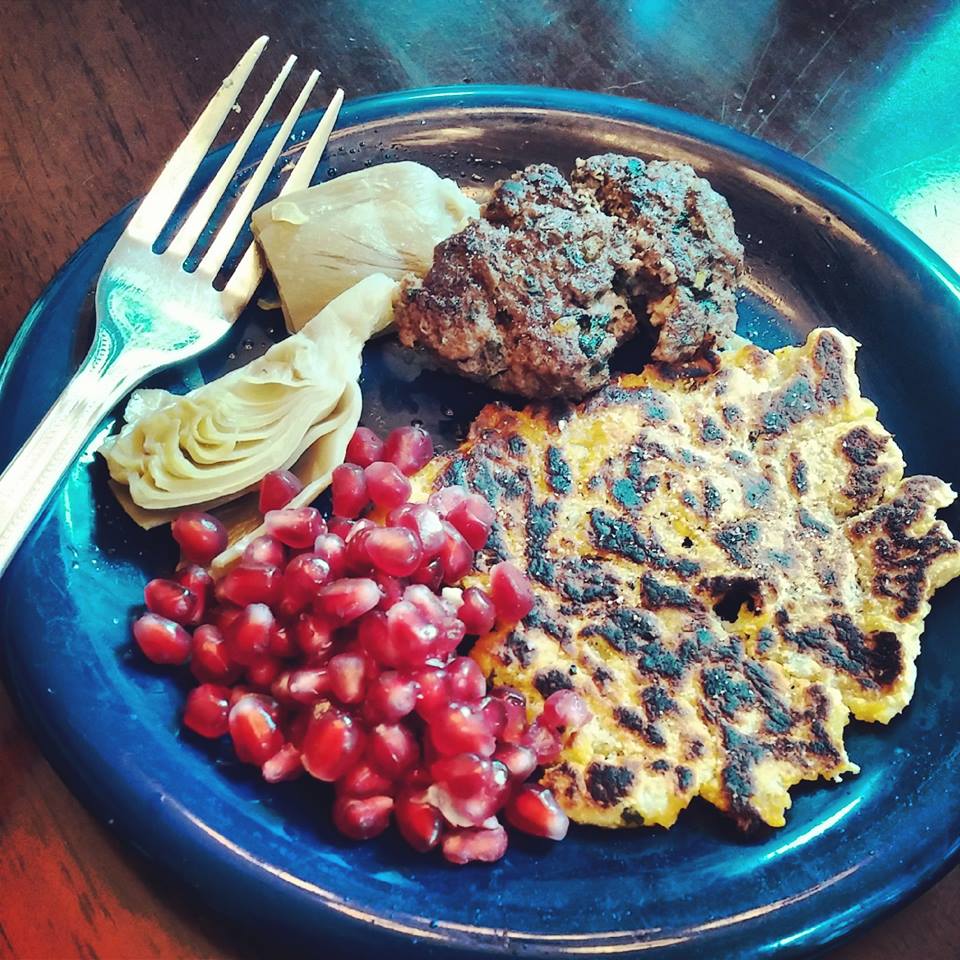
My weird breakfast:
Grass-fed beef patty with parsley (antihistamine) and thyme (anti-bacterial, anti-inflammatory, antihistamine);
artichokes (contain quercetin, luteolin and rutin);
sweet potato (anti-inflammatory, contains rutin and quercetin) and butternut squash latke (antihistamine, anti-ulcer, anti-inflammatory and antidepressant action);
pomegranate (mast cell stabiliser, anti-inflammatory).
**Info from thelowhistaminechef.com**

Another weird breakfast:
Grass-fed beef patty with parsley (antihistamine) and thyme (anti-bacterial, anti-inflammatory, antihistamine);
sauteed with spiralized zucchini (has anti-inflammatory, anti-ulcerogenic and potentially antihistaminic properties);
cauliflower (contains anti-inflammatory vitamin K) and sweet potato cake (anti-inflammatory, contains rutin and quercetin);
apple sauce.
**Info from thelowhistaminechef.com**
I started to feel a bit better overall in late January, right after my bad pre-syncope episode during my period and right after I quit oats. By “better”, I mean back to where I was around September/October of last year. Able to walk 800-1000 steps a day instead of 500, my daily headache got better. But still not going into the garden, not stretching, not able to talk very much. One amazing change is my heart rate has gotten much lower overall ~ almost too low. In the 70s and 80s when I am standing up, not moving. Mid-50s sitting, watching tv. Low-50s and high-40s sometimes, while lying down in bed.
I refuse to believe that eliminating oats made the change.
A) Because I love oats too much and can’t wait to eat them again. I HATE savoury breakfasts. Hate them. Make me sick and nauseous. I was the one going to the Irish pub for a Sunday fry with my family and ordering porridge or fruit, yogurt and toast. Every morning is a struggle. It has gotten easier, but it’s not enjoyable. I don’t want acorn squash and beef and kale for breakfast and I never, ever will. It’s one of the reasons I have continued to search for “baked goods” recipes and kept rice in my diet (so I can have rice cereal or rice toast, if I like).
B) Because nothing can ever be definitive in such a changeable, cyclical disease. I also stopped taking my B-complex around the same time. That could have been causing my headache everyday!

Banana-Zucchini muffins: click image for recipe
In the final diet post, I will discuss AIP (autoimmune paleo diet) and all the other complications and sensitivities one comes across when researching online. It’s enough to send anyone straight to the nearest fully gluten-ized and dairy-fied bakery.
It’s 8am and I’ve already been awake for 3 hours. I’m sick and unemployed, I should be sleeping ten hours a night. I should be sleeping late and luxuriating in the fact that I no longer have an alarm clock going off, a company to oversee, and bosses to answer to (… and bosses to whom to answer). My brain should be able to shut down and heal. It’s February, for fuck’s sake. Time to hibernate. I’ve been missing exciting life and getting absolutely nothing done for 17+ months now ~ why does my brain feel like it has to be on high alert ALL. THE. TIME?
Throughout the day, I’m a dizzy zombie, unable to accomplish anything, but my mind is weakly turning over like the Little Engine that Could trying to get up that hill: What do I need at the store? What could be causing my forehead rash? What will I eat for dinner? Will I try a sleep drug tonight? And then the night rolls around and that little engine reaches the top of the hill and starts to fly down the other side: HOW DO WE NOT END UP DESTITUTE? HOW CAN I MAKE MONEY? I NEED AN M.E. DOCTOR! WE NEED TO MOVE!
So, it feels like ~ and I think it’s the reality ~ I never deeply sleep and I never truly awaken. I am existing in a netherworld, a slightly off-center plane of existence where everything is blurry and too bright, where everything is too loud, but also muffled under ear-ringing… a place where you try to do something month after month, but, during the day, it’s too much energy and, at night, it’s too… sepulchral.
Case in point: I honestly thought it had been about one month since I wrote my diet post, but I see it has been more than three months. That’s a quarter of a year. Three months from now, I will be 41 and it’ll have been a year since I wrote “birthday present thank you cards” on my to-do list (they’re still on the list). Actually, three months from now it will be exactly 5/19 (in American date writing) and those closest to me know that that number means something (what, exactly, I don’t know. One day I’ll write a post about my weirdness with numbers).
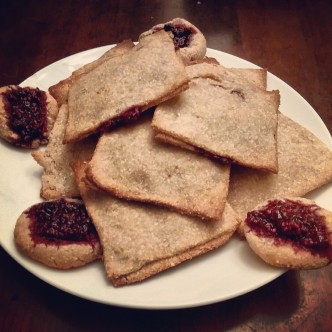
raspberry pop tarts
Today, I woke up starving. It’s now 11:30am and I have already eaten a raspberry “pop tart” (click above image for recipe), some apple, a beef breakfast burger with acorn squash and coconut cream, and a mug of bone broth with sauteed kale, asparagus and parsley.
To continue the saga of how I got to this strange way of eating: When we last discussed food, I had just started a strict low-histamine diet. Before ME, my crazy heath history included idiopathic anaphylaxis, autoimmune urticaria and angioedema, flushing, vasovagal syncope/shock, and a slew of other things that could be caused by histamine intolerance and/or a mast cell disorder, such as medication reactions, dysmenorrhea, osteopenia, headaches, tinnitus etc. I thought if I were very strict with the diet, I’d be able to quickly tell whether or not it would make me feel better. I poured over online histamine lists for weeks. Information is very conflicting because histamine levels fluctuate based on where the food was grown, when it was harvested or slaughtered and how long it has been in storage. Also, if you listened to the interview with Dr. Joneja, you know that histamine is a very important neurotransmitter in your body, but it can build up over a period of time and, if your bucket is overflowing, you will have a reaction. In other words, the salmon with lemon on Monday may not do any harm and neither might the wine and chocolate on Tuesday, but the eggplant on Wednesday might just put you over the edge and you have flushing, a migraine, hives. Or worse, anaphylactic shock. It is a process of trial and error for everyone attempting this diet. You have to figure out what affects your body.
The two best histamine food lists I found were Dr. Joneja’s and this one out of Switzerland, which shows histamine liberators and DAO inhibitors (more on this later) as well as foods that are naturally high in histamines. If you are as insane as I am, you can look at the strictest list possible, which I compiled from the two linked lists as well as about five others. My list is so short because I wanted to know the foods that everyone agrees are probably safe.
I ate strictly low-histamine foods for about month and, let me tell you, it was far more difficult than all the other diet modifications put together. Even a loose attempt at low-histamine is a slice of hell. The dilemma in which I found myself was that I kept adding elimination on top of elimination. So, over the course of 20 months, I had eliminated gluten, tomatoes, eggs, and strawberries; then dairy, legumes, all grains but oats, nightshades, and most processed food; then soy, citrus, pork, red meat, lunch meat, shellfish, condiments, maple syrup, and honey. I added a few things back (rice, red meat, honey), but everything else stayed out. Once you adapt to certain meal staples, it is difficult to change ~ especially when someone else is shopping and cooking for you. And then, on top of these, I went low-histamine. I stopped eating most herbs and spices, spinach, avocados, sweet potato, chard, all vinegar, all fruit except apples and pears, all fermented foods, leftover foods, all fish, chicken… and red meat was out again. It was these last few that set me up for the fall. Having no leftovers in the fridge left me scrambling to find things to eat. I hadn’t figured out how to buy the freshest meat or the process of cooking and freezing to ensure I had meals on hand. I hadn’t figured out how to get enough protein when I wasn’t eating dairy, legumes and most meats. I decided not to give up nuts and seeds, which are avoided on the strictest histamine lists, because they were providing the vast majority of my protein. Still, they weren’t enough and my blood sugar started crashing daily, sometimes multiple times a day, sometimes in the 40s and 50s.
If anyone has experienced severe hypoglycemia, you know how scary it can be. Suddenly I didn’t care about any other symptoms, I just needed my sugar to stablise. Mainly veg does not work for my body. And so my husband became the Fresh Meat Scavenger and I became the Great Meat Eater.
To be continued (sooner than three months from now) with honourable mention to ketogenic, alkaline, low-salicylate, migraine, mold, AIP, and low-sulfur/thiol diets…
As a Valentine’s Day present to my husband, I decided to get marginally dressed again. I put on a bra and a red dress. Unfortunately, the dress, although clean, hadn’t been worn in a while and it smelled musty, so I switched to a pink sweater (pink and red are really living on the cutting edge of colour for me; they scream: I’m dressed up! I’m making an effort! ~ 90% of my wardrobe is black and grey) and leggings that have pockets and corduroy-type ribbing, so they give the impression that they are more civilised than mere cotton leggings. And I put on my new boots. I won’t take a picture every time I put boots on, I swear, but I never thought there would be a pair of flat boots that I liked and, more importantly, were proportional to my munchkin frame.

Unfortunately, after two changes of clothes, my battery is almost dead and I’m dizzy and incredibly drained. I woke up feeling okay, excited that I wasn’t feeling evilly ill, but how dare I pull on leggings that take a bit more effort than PJs and bend down to put on boots rather than slip my feet into slippers? It was too much and it’s only 11am. I know I will be wiped out when my husband gets home.
The entire plan was: get dressed, brush hair and maybe put on make-up. Although, all my make-up is 2+ years old and putting it on means holding my arms up in front of my face, which is a lot of energy, and it also means having to take it off. Exhausting. I wracked my brain to think if there was something I could do to surprise him. Cook dinner? No way. Clean the house ~ or even just the sitting room? Nope. Buy a present? Too late to do it online and I wouldn’t know what to get, anyway. And we’re trying to conserve our savings. So, I think my present is going to be yet another card thanking him for saving my life every day (because, make no mistake, I would be in a very different predicament without him) and wearing clothes that kind of fit me.
The funny thing about my husband is, he would never notice what I’m wearing. I could be sitting on the couch in a ball gown and he wouldn’t bat an eye. I kind of love that about him. I certainly never have to feel self-conscious about looking slovenly. He tells me I’m beautiful even on my sickest days. Love is blind.
One of the most distressing symptoms over the last year is hair loss. Never could I have predicted that I would be upset about my hair. I don’t really like hair. I’ve always preferred men with shaved heads and, half the time when I’m talking to people, I’m thinking about how much I want to tuck their hair behind their ears or put their hair in a ponytail. I find it distracting (and kind of gross) that every woman on tv has what I call “hair curtains”. Long waves down the sides of their face that are pulled forward so they have this weird part in the back of their head and no hair down their back.

Hair curtains.

Weird back of head.
So, what do I care if I have less hair? Well, my hair loss makes me look even more sickly because it is concentrated in the front and on top. You can see my scalp too much and there are clumps of short hairs that are either breaking off or just won’t grow any longer. I was on a Facebook group and someone mentioned that, because she was in the military and constantly wore her hair in a bun, she was going bald on the top of her head, so she cut her hair short. Light bulb! I’ve worn my hair up every day for the last 17 months that I’ve been housebound. So, I’m cutting it short. I’ve had my hair very short before, so it’s not a big deal, but I do have a few concerns: 1) I can’t dye my hair now, so there is a lot of grey. I’m not sure how I’ll like short greying hair. 2) I can’t wash my hair very often and, when it’s dirty, it’s nice to be able to put on a hat and still have the illusion of clean from the long hair coming out below the hat. 3) You can put long hair up in such a way that it gives the illusion of being more “dressed up”. But none of these things will sway me because I have to wear a CPAP! The headgear on a CPAP mask is hell with long hair and is undoubtedly contributing to the hair loss.
My sister’s hair stylist is going to make a house call, bless her heart. I wish I had longer, lovelier hair and I could donate it like Marie did, but I just don’t have the patience to grow it. The point of all this is to say that I guarantee my husband doesn’t even notice when I cut my hair. I have left the house with long blond hair and come back with a dark brown bob and, even when prompted, he couldn’t figure out what was different. When he met me, my hair was very short and fiery red. He’s pretty much seen it all. Luckily, days before I met him he had shaved off his long hippy hair. I sometimes wonder if I would have fallen for him if he had a ponytail. Probably. Love is blind.
Happy Valentine’s Day.
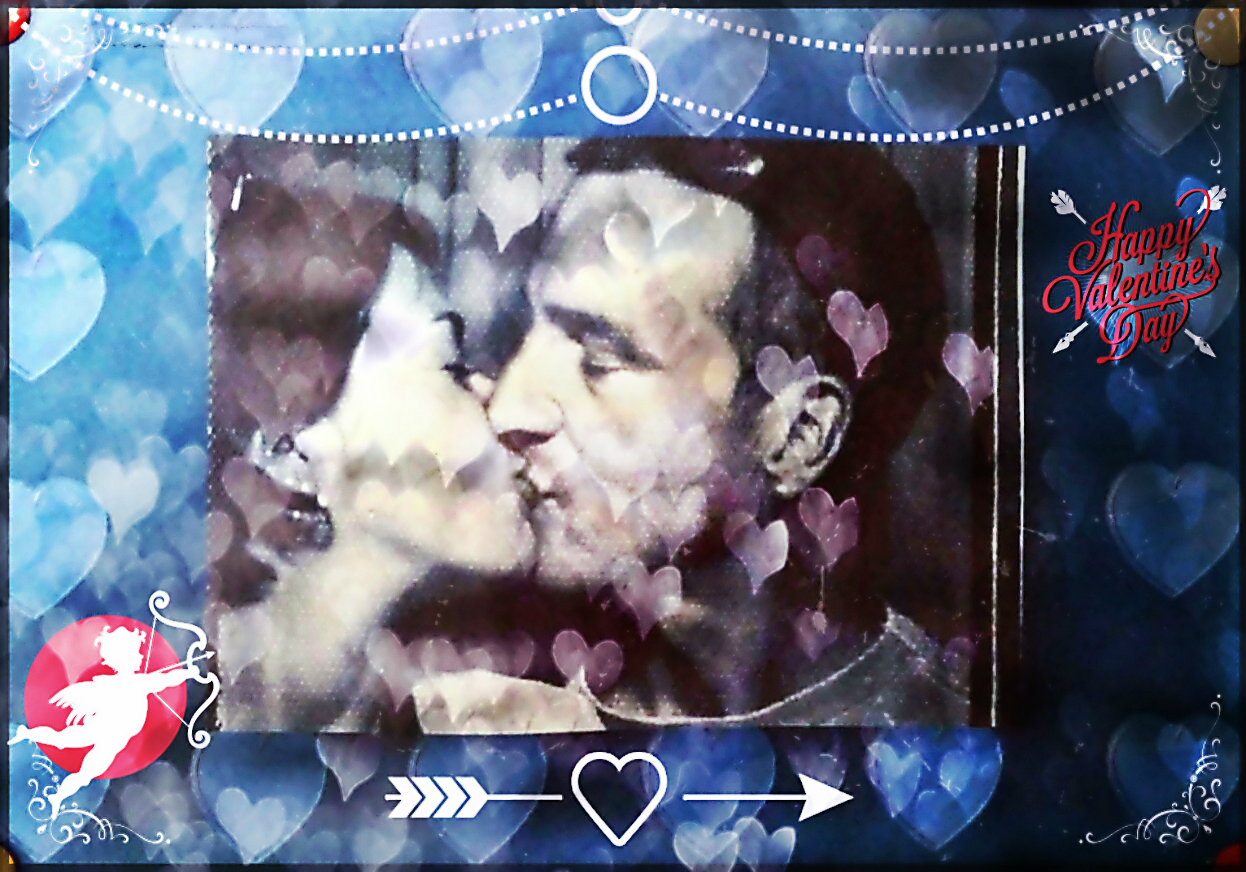
1998
 Rag and Bone Shop of the Heart