Best Endocrinologist Ever.

Every time I have an appointment with my endocrinologist, I hem and haw about whether I should cancel it. It’s on the other side of town, $50 round-trip in an Uber, it only ever lasts about 20 minutes and couldn’t she just look at my thyroid lab results and email me about whether to stick with my current hormone dosages? Well, each time I go, I am so grateful for this doctor (last week I told her nurse I would walk on hot coals for Dr. B) and I vow to come straight home and write an update so I can remember everything she said. I never have managed to do this and the visit summaries hardly mention anything at all, so today I’m going to write a general update of her treatment.

I’ve seen a lot of endocrinologists in the last six years and they have all, without exception, been kind of odd, stoic and monosyllabic. Until Dr. B. She’s vibrant and engaged (after seeing her, I always mourn my lack of brain energy a little more), listens closely, talks about her ideas out loud, thinks outside of the box and is interested in conditions not typically related to the endocrine system. Imagine that: a big hospital allopathic endocrinologist taking the whole body into account!

The first time I saw her a year ago, I told her my basic story (anaphylaxis 2001-2002, vasovagal collapse 2005-2011, thyroid goiters 2009, radioiodine ablation 2010, SICK 2011), assuming she’d check my thyroid and update my prescription as per usual — and she did, but she also ordered pituitary blood tests, a Cortrosyn stimulation test (CST) (otherwise known as an ACTH stimulation test — it measures how well the adrenal glands respond to ACTH), referred me to two neurologists — one that specialises in headaches and one that specialises in dysautonomia — and said we would consider placing a continuous glucose monitoring device to assess the drops in my blood sugar (good news is, my blood sugar crashes got much better, possibly because I am eating all foods again and have put on weight). No other endocrinologist had ever suggested any of these things.

I was dreading the CST because of my reactivity and intravenous injections of anything don’t allow me to start low and slow, but it was fine. I did my research beforehand (yes, they were they only using 1mcg of Cortrosyn; no, I didn’t need to fast; no, it didn’t need to be timed according to the follicular phase of my menstrual cycle; no, I didn’t need to be off bioidentical hormones; and, yes, my husband could be with me), so I felt comfortable about the procedure and the results were normal.

The pituitary testing showed low LH (luteinizing hormone), DHEA and IGF-1. Because of the latter, at our next appointment Dr. B ordered a pituitary MRI to “leave no stone unturned” (LOVE her). The MRI was normal, but she emphasised that it was less reliable because of my unwillingness to use contrast (I didn’t think the risks of a reaction outweighed the benefits of a better MRI — and she was ok with that). She also gave me a prescription for Florinef to see if it would help with my hypotension (blood pressure was 80/60 at this appointment). I trialed it for a month (starting at 0.0125mg (!!), working up to 0.1mg) and thought it might be increasing my headaches (but not my blood pressure, of course), so I stopped, but it’s still on my list to retry.

My thyroid levels have consistently been tanked for the last 6 years and at every appointment Dr. B would tweak my meds. I’ve gone from 50mcg/day of levothyroxine to 100 to 125 and from 5mcg/liothyronine to 10 and — this is exciting — when I told her my naturopath suggested much higher T3 and lower T4, Dr. B said, “I’m totally open to that, let’s try it.” 😮 Typically allopathic endocrinologists and NDs do not see eye to eye on treatment and optimal thyroid levels and often one doctor will be resistant to another doctor’s suggestions, especially when the suggestion comes from someone who isn’t a specialist. Dr. B has no ego getting in the way. So, we increased my T3 to 15mcg twice/day and lowered T4 to 100mcg. I really don’t know if it has helped, but she seems more satisfied with my thyroid levels. She told me to watch out for tremors, heart palpitations and insomnia, but they are all within my normal constellation of symptoms, so who knows (although, as I’m typing this, I realise that my quite-vicious nightly palpitations haven’t happened in a while– maybe weeks). She diagnosed me with “euthyroid sick syndrome” which essentially means your thyroid will stay sick until the underlying chronic illness gets better.

I saw a headache neurologist and a dysautonomia specialist (more on both of those in separate posts), but neither of them were the ones to which Dr. B referred me. And — another reason to love her — she had no problem with that and was still interested in what they had to say. Even better, when I told her the dysautonomia specialist didn’t have much to offer and essentially told me just to make sure I don’t decondition any further, Dr. B raised her eyebrows in surprise and kind of dismissed this, still interested in helping me fix this piece of the puzzle (those of you that haven’t done the doctor rounds might not realise that almost all of them tell you to simply exercise more (or gain/lose weight) (or take antidepressants), so I expected Dr. B to take the specialist’s assessment as bible and agree that I was just deconditioned). She suggested I do a growth hormone challenge (it involves a 17-hour fast, an 8am check-in and a 5-hour test where they give intravenous glucagon and then measure human growth hormone (HGH) response through blood draws) and said the worst side effect she’d seen was vomiting. I wanted to vomit at the thought of getting to a hospital at 8 in the morning. I went home to do some research; that was in July of last year.

When I saw her again at the end of September, I hadn’t done the HGH challenge and she didn’t give me a hard time at all. Three months after that appointment I still hadn’t found the nerve, so I emailed her a long message about my glucagon fears (those of you with mast cell/anaphylaxis/medication sensitivity issues can read my email* below for the reasons it gave me pause) which any other specialist would either not answer or reply that I should come in for an appointment to discuss. Instead, she sent me a very thoughtful, validating reply (not “For fuck sake, stop being such a scaredy-cat and do the bloody test since I’m the one doctor who is investigating all these things!”) and offered an alternative to glucagon — an insulin challenge test — which I agreed to … and then never did. They give you intravenous insulin, drop your blood sugar to 40 and then test HGH. I told her I was more comfortable with the devil I knew (hypoglycemia) then the one I didn’t. But, it turns out I’m not really comfortable with voluntarily meeting any devil. I’ve had my blood sugar drop into the 40s. It was absolutely horrific — one of the worst feelings I’ve ever felt. And, although they give you intravenous glucose right afterwards, I still couldn’t bring myself to do this test and subject myself to the crash when I thought they probably wouldn’t find anything.

So, I waited until my appointment this month — 8 months after she first wanted to investigate this avenue — and told her of my fears about the insulin challenge test as well. I expected her to just give up, to say there’s probably nothing wrong there, anyway, but she didn’t. She said there was an additional reason to do the insulin challenge (other than for HGH output) and that was that it can pick up a hypothalamus issue that the glucagon stimulation test can’t. Ok, I can get on board since it’s a two-fer. However, in another display of out-of-the-box-ness and medical generosity, she suggested I just try HGH injections without doing the challenge test. She said she had two other patients with the dyautonomia-mast cell-EDS trifecta (more on my EDS diagnosis at another time) and, even though neither one flunked the stimulation test, they tried HGH and had really good results. A friend of my sister-in-law’s had a lot of success with HGH and it has always been in the back of my head as something to try when I win the lotto. I read it cost thousands of dollars, but Dr. B’s prescription is “only” $138/month, so I’m on board. If/when I get the nerve, I can stop the HGH for a week and do the challenge test and, if I fail, insurance will pay for my prescription. An added bonus is my nurse who comes to my home every week (to give me intravenous fluids with my immunoglobulin infusions) can show me how to subcutaneously inject the HGH and I don’t need to go across town for a tutorial appointment.

Gratitude for good doctors! Wish me luck with the HGH.
Oh, I’ll be free… (immunoglobulin infusion success)

The first time I ever passed out was in a blood plasma donation clinic in Madison, Wisconsin. My brother, who had attended the University of Wisconsin before I did, tipped me off that they paid quite well for plasma, so every so often I would go spend a few hours in a big comfy chair with my vein tapped. On this particular day, I suddenly got very dizzy, nauseous and clammy and the next thing I knew I was coming to with ice packs under my neck and the chair tipped all the way back so my feet were in the air. I was sweaty and shaky, but I stayed until the plasmapheresis was over and got my cash. I didn’t think twice about it and continued to donate plasma until one day, during the prescreening tests, I came up positive for heroin. It turns out it was because of the poppy seed muffin I had for breakfast, but it didn’t matter, I was not allowed to give plasma again. One abnormal test and you were no longer a candidate. I never asked what plasma was used for and it certainly never crossed my mind that I, myself, may need a medication made from thousands of people’s plasma donations.

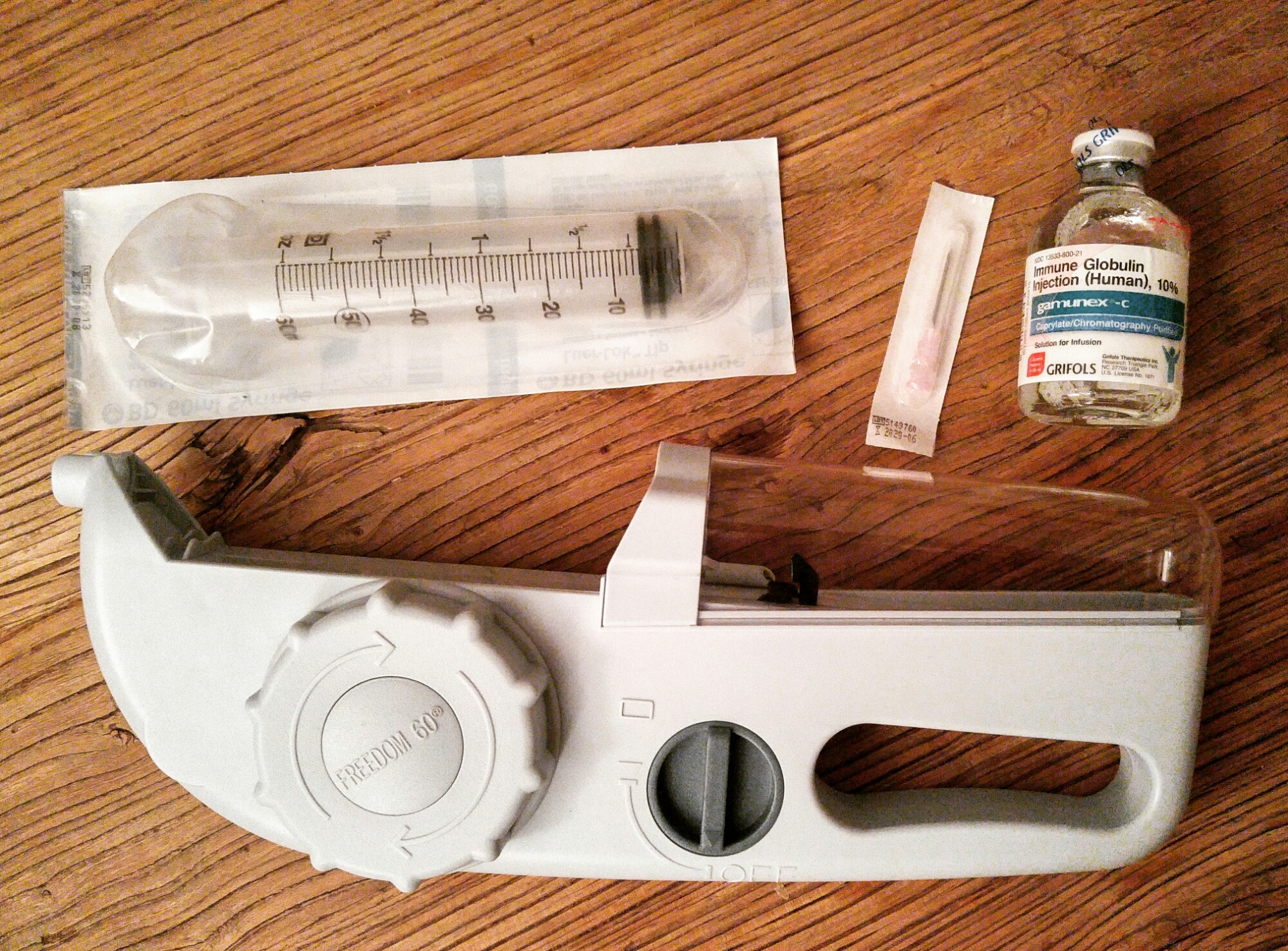
I’ve been getting weekly immunoglobulin infusions for 4 months now and it’s become routine (prior posts about this treatment can be found here and here). Not only routine, but to keep the success going, my superstition causes me to keep everything identical each time. I drink 4 liters of water the day before, the day of and the day after my infusions. Every Monday, I tidy up, run the Roomba and take a shower. I drink electrolytes, make my chicken and vegetable soup and don’t take any supplements. I take 3mg Prednisone, remove the saline bag and Gamunex from the fridge and wrap the fluids in my heating pad. When my nurse arrives, I get into bed and she hooks up the IV and sets the pump. Half an hour later, I take 650mg Tylenol, 25mg Benadryl and 10mg Zantac and then, before the Benadryl kicks in, I prep the Gamunex (I have to suck it from the vial into a fat syringe, which is surprisingly hard to do and painful on the hands). After the saline has been running for an hour, I insert 4 subcutaneous needles into my thighs. I could use wider tubing (for a faster infusion rate) or fewer needles, but, again, I’m sticking with what works, even if it’s not the norm for other patients. For the first few months, I did change where I inserted the needles, trying different areas on my belly and legs, but now I stick with the inner thighs which proved the least painful for me. I then fall into an antihistamine-stupour sleep and my (wonderful) nurse leaves once my husband gets home. In theory, she could leave as soon as she has inserted the IV catheter, which would be a half hour max, but because of my history of reactions and anaphylaxis, she’s extra cautious. By 8pm, I can disconnect the IV, remove the infusion needles and go downstairs to make dinner (this treatment makes me ravenous).

image

When I first started infusions, I would have to take more Tylenol and Benadryl at around 9pm, my sleep would be horrid for a few nights from the steroids and I’d be dragging and headachy for at least a day afterwards. Recently, besides sleep, which will be my nightly nemesis forevermore, it seems, I haven’t had any problems. No need for extra meds, no dragging, no headache (except later in the week, which could be because I drastically drop off my hydration). In fact, it almost feels like my body is eagerly drinking up the infusions each week. In fact… the last 5 or 6 weeks have been… so nervous to say it (cover your ears, gods!)… good. Some of the best weeks I can remember. I feel freer — less restricted by pain, less confined by finite energy reserves, able to push boundaries without fear. My headaches have been more infrequent, my skin is better, my debilitating neuro symptoms have been more intermittent. I’ve been driving to nearby appointments again and I’ve been able to talk to the point of being hoarse, but without a weak voice. This last thing is very exciting to me.

My pilot brother was here on a layover and I was able to talk and laugh with him for almost 6 hours. My voice was tired, as if it were an unused-muscle, but it wasn’t weak in that way it’s been for years where I could barely contract the muscles to get the air past my vocal cords (or something). I was most definitely dizzy and deflated from the energy expenditure (my brother is a bottomless well of entertainment and conversation), but I didn’t have payback. Before he came, my brother texted me and said, “I’d love to see you, if only for an hour” and I realised how much worse I’d been the last time he visited in 2014: I remember wilting weakly an hour into our animated discussion. What glorious freedom to ignore the lightheadedness and tightening muscles, ignore the raised heart rate and blurring vision (because I’m still very far from normal), and not be terrified of repercussions. To have the option to push through! In the past, I’ve crawled to my room mid-visit — not out of cautiousness, but because there was no other choice and I always feared becoming permanently worse if I strained too much against the restraints.

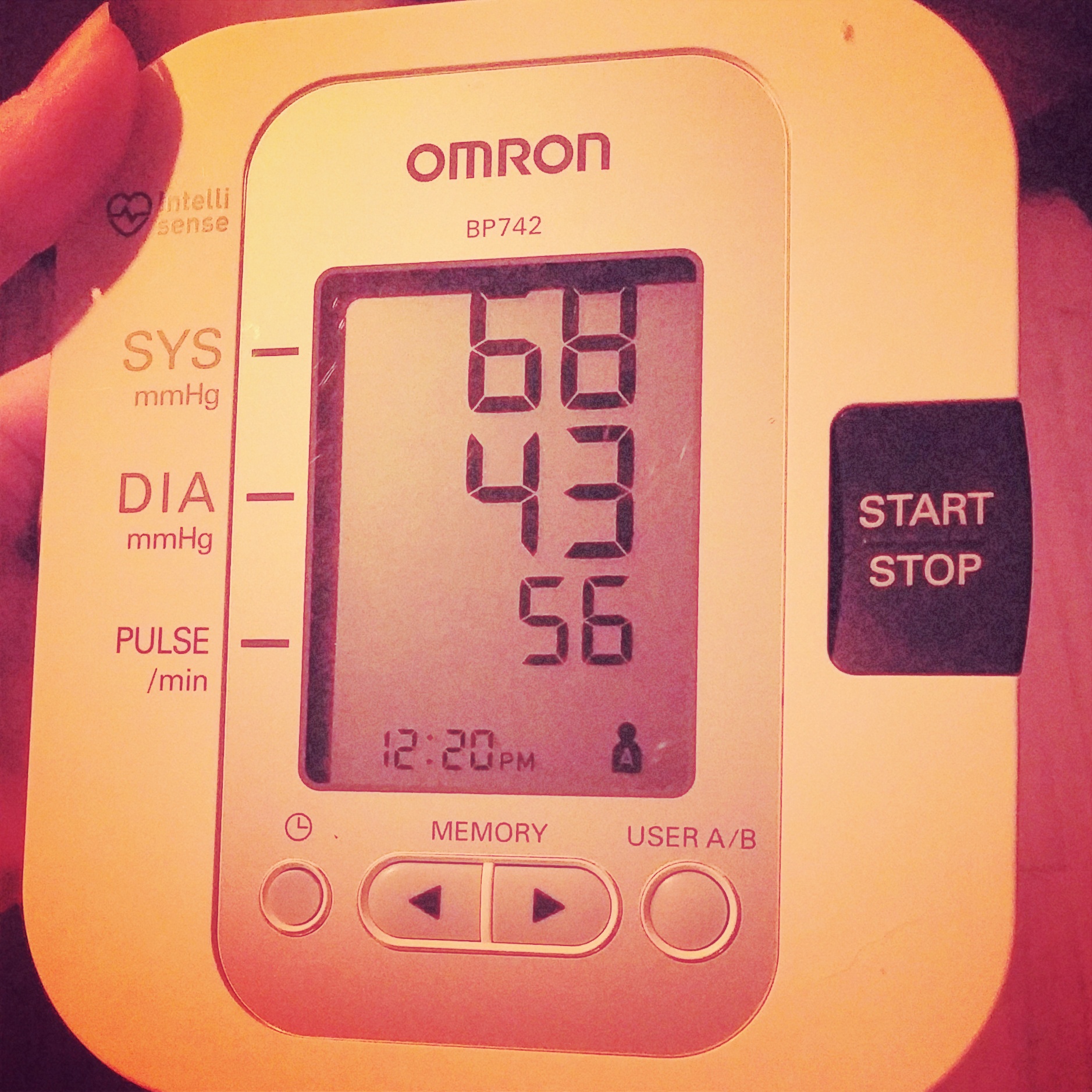
This uptick could be because of a liter of IV fluids each week — it would explain why I’ve been having bad days later in the week — but I don’t think so. I usually feel kind of puffy and swollen afterwards and my blood pressure hasn’t increased at all; it stays steadily around 85/45. We’re considering experimentally doing some infusions without fluids and see how I get on, but I’m hesitant because, like I said, I like to keep everything consistent. Also, in the past I’ve asked so many doctors to help me with a trial of weekly IV fluids to see if it would help dysautonomia symptoms, now that I have them, I don’t want to give them up.

I want to mention one small thing that I’m incredibly excited about, which will sound so insignificant to most people. About a year into this illness, a few things happened to my body seemingly overnight and they always make me quite sad. The whites of my eyes changed colour, vertical ridges appeared on my once-smooth nails and I became allergic to my platinum engagement ring, which had been my grandmother’s and I’d worn 24 hours a day for years. Every so often over the past 3 years, I would put my ring on and, after a few days, I’d develop big itchy, sore bumps and discoloured skin and have to take it off again. I tried again just after Christmas and, 4 weeks later, I’m still wearing it with no problems. I want to add loads of exclamation points to this!!!!!! For me, that is so much more encouraging than IgG blood tests in the normal range or being able to walk more steps each day. My body has stopped rejecting something — a precious thing — that swiftly angered it over and over for so long. Rejoice. 🙂

Feeling emboldened, I asked my doctor if we could increase the dose or the frequency of my infusions or if I could add in a new treatment (antifungals, antivirals etc.). She said no — and I quote: “You are exactly where I want you to be.” That is so great to hear and such a reversal from my usual position of moving much more slowly than my doctors would like. She wants to continue my treatment indefinitely, raise my IgG levels as much as possible and then retest for infections in about 6 months to get a new baseline.

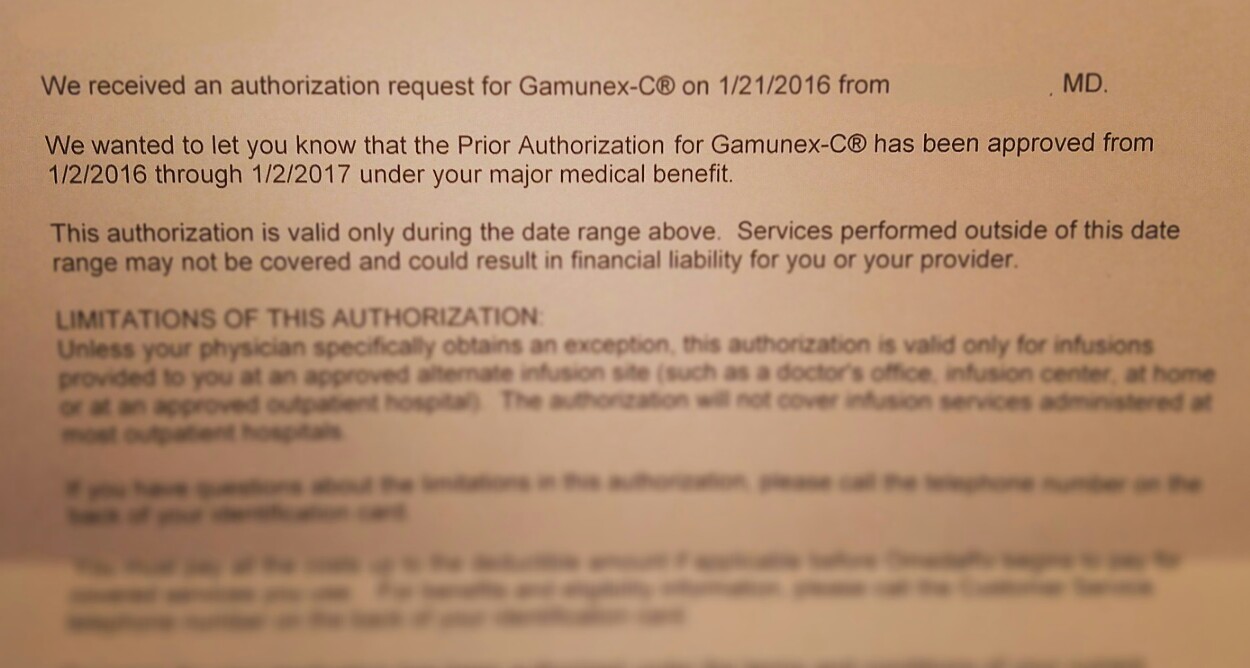
Insurance coverage always scares me; I’ve heard such horror stories of the battles to get treatment approved and, even after approval, actually paid for. My infusion bills were $943 for the first 3 months and I feel very fortunate that it’s so low. SCIG is the only thing that I can definitely say has helped in 4.5 years of being sick and, after 6 doctors refused to help me get the treatment, I feel immeasurably grateful to Dr. I for not only suggesting IVIG herself (I didn’t bother to ask because I’d given up at that stage), but allowing me to start on such a low dosage and increase slowly. No immunologist would have agreed to this. Yesterday I got this letter and almost wept (with joy). Thank you to the good doctors and nurses, to everyone that donates plasma (especially the broke college students) and even (in this case) to the all-powerful insurance companies who help perpetuate this dysfunctional healthcare system.

image

———————————————————————————————————

I wrote this post on Thursday, the day after I’d driven to the dog park by myself, feeling victorious, and delighted my Bowie by walking further around the path than I have since being sick. I was still doing okay the next day and wanted to finally update everyone on my exciting progress.

image

I’m not saying the chronic illness gods read my blog post draft and decided to tip the scales in the other direction because that’s just crazy nonsense, everyone knows that. But I did wake up not very good yesterday and I’m even worse today, with a bad migraine. Don’t get me wrong, I constantly remind myself that my husband used to have to wash my hair, but it’s still difficult to let yourself get a little bit excited (and in reality, “get a little bit excited” in my world means I’m thinking, “I’M GETTING BETTER! THIS IS THE YEAR! I’M GOING TO LEAVE THIS DISEASE BEHIND! I’LL BE FREE!”) and then have such a harsh reminder. Maybe the difference now is… I’m not scared.

Title Credit

March Update

I haven’t done an update in forever and it’s a shame because I look back on my updates a lot to see how I was in the past and compare it to how I am now. It looks like I’m at about the same level of functioning as I was at this time last year. A little worse, unfortunately. Last year, I was walking more steps, had been out in the garden more, was driving a bit (I drove to an appointment this week for the first time in forever, so there is some progress).

I’m still trying to regain some ground after the onslaught of nocturnal mast cell/viral/ME/inflammatory bowel reactions that started in September when I tried Cromolyn. Thanksgiving and Christmas were probably the two sickest nights of my life. As soon as I was resurfacing from Christmas, I got hit by another one on January 12th. As soon as I was feeling recovered from that, I had another one on January 28th and then again on the 31st. I stopped everything, including writing. For three weeks, I laid low and tried to reset my body. My constipation had become severe, so I had been taking massive doses of various different kinds of magnesium and I was afraid this was contributing to the episodes because there always seems to be some sort of bowel inflammation component involved (I get aches and what feels like electric pins and needles in my bowels and my flanks when I’m very constipated). When I quit magnesium, the constipation became critical — and a bit comical with the size of my protruding belly. I’m so uncomfortable, I wake up in the night when I roll over onto the poop baby inside of me. Where do the other organs go? I’m not sure how I continue to eat and I’m not sure why I continue to eat. You’d think at some stage I would just give my gut a break and eat liquid food, but I’m always hungry. I tried Triphala, Gentian, Medibulk, digestive enzymes, massage, enemas, prunes, oatmeal, even my old standby Wormwood stopped working. Which led me to the glycerine suppository on Oscar night which caused the (anaphylactic?) collapse on the bathroom floor. So, tonight I’ll be taking the generic polyethylene glycol (Miralax/Movical) that I have been avoiding because, if it’s too harsh, it’ll trigger a vasovagal reaction and I could pass out or, if it’s mild cramping, it’ll keep me up in the night. Not to mention it’s a nasty drug and probably made in China. But enough about that…

My father was visiting when the suppository episode happened and, a few days after he left, my mother came. That’s it from Christmas until now. That is my 2015. One quarter of a year summed up: reaction-recovery-reaction-recovery-reaction-recovery-reaction-recovery-visitor-visitor. Thank god for the visitors because the rest is really depressing. My friend M recently said that he fears not seeing those he loves ever again and, as we get older, that concern becomes more and more pressing. I think this all the time with my parents living so far away. Their visits allowed me to breathe easier. They filled me up with sustenance and gave me a little more mettle to carry on. I am incredibly lucky to have such a supportive and loving family. Recently, Jen Brea asked the ME community to post the most compassionate word or giving act ever received in relation to our illness (a very moving thread) and all I could think was, my family, my siblings, my parents, my best friends… their messages, words of encouragement, interest in learning about ME, physical help, monetary help, emotional help… Where would I be without them?

Both visits were wonderful and were needed more than I realised. My mother helped me with a hundred tasks I haven’t been able to accomplish and I got to hear all about my brothers and nieces and nephews, whom she had just visited. We managed to drive to the beach dog park twice: first, with my father and sister and, again, with my mother. It has been glorious weather in Seattle and getting out of the house is always the highlight of my months.

IMG_20150310_012431

IMG_20150310_011809

Yay! Beach!

IMG_20150224_191024

Damn, he’s a fine looking dog. ❤

The one downside was, my husband wasn’t with us the first time, so I was without his deafening whistle and another set of eyes on our smaller dog, Riley, the escape artist. He ran around the rocks at the edge of the park and took off, causing me to expend more energy than I have in many months. I stood calling at the top of my lungs, over and over, “RILEY, COME!” and then started to panic when he didn’t reappear. At the top of my lungs and panic are not things that go well with ME. My voice is not strong, but, man, when my child went missing, nothing was going to stop me yelling for him. This is a dog that is only ours because he ran away from some other home and was found in a house barn, emaciated and unable to stand up. He’s an adventurer and curious about everything, while Bowie sticks to me like glue.

When Riley finally came into view, he was up in the car park and I sprinted up the sand embankment to the fence. Sprinted and up don’t happen in my world, either. Riley looked scared. He couldn’t tell where my voice was coming from and I was worried he’d run in front of a car or disappear, never to be found. He was tearing back and forth outside the park and I was calling over and over. He finally found me and I grabbed the scruff of his neck through the fence and sat down in the sand, waiting for rescue. My 72-year old Dad clambered up the rocks (cutting his shins in the process) and got Riley on a leash. I was half catatonic on the way home, like a rag with all the water twisted out of it. I crawled to bed, but, once again, bounced back quicker than I anticipated. And it was worth it. Mount Rainier on the drive home, through my glazed eyeballs, was spectacular. My Dad said it looked like a painting of Mount Fuji.

So, what else can I tell you about the last 3 or 4 months? I haven’t really taken any supplements this whole year so far. A few here and there, but, after every big episode, I would stop everything and go back to baseline. In the last week, I have been taking trace minerals, Vitamin D, K2 and fish oil again. I’m also still on topical DHEA and progesterone and just added topical pregnenolone and I’m about to add oral progesterone. It makes me nervous using bioidentical hormones, but they don’t seem to cause a reaction and both of my NDs recommend them, so I’m going with it. Apparently, there is evidence that DHEA+pregnenolone can reduce reactivity, so the goal is to take those for a while, then try IV fluids, then try sub-cutaneous IG and maybe even make my way to IVIG one day. I’ve been trying to get there since seeing Dr. Chia 7 months ago, so who knows how long it’ll take. I’m also still on the compounded thyroid hormones. All these compounded meds are costing me a fortune, though, and are not covered by insurance. One of these days, I’ll have to call this experiment quits and go back to my generic, dye-filled, filler-filled drugs. That’s it for what I’m taking. The Equilibrant, Nystatin, Hydroxyzine, Tramadol and Singulair are all languishing in the cupboard, unopened.

I had a few blood tests done in January. The big shock is that my cholesterol is sky high. Total cholesterol is 310, LDL is 194, Apo B is 124 (ideally <109) and LDL-P (particles) is 1755 (ideally <1000). There could be many reasons for this: my continuing low thyroid, my chronic and reactivated infections (coxsackie, HHV6, EBV, varicella, candida, mycoplasma pneumoniae), leaky gut and inflammation, genetics (both of my parents have high cholesterol) or something to do with my insulin/hypoglycemia issues. But, I actually think it is mostly to do with my diet. Over a year ago, I started an elimination diet for autoimmune conditions (AIP), plus cut out most high-histamine foods (fish, shellfish and avocado etc.). I cut out oats (I had already eliminated all other grains except rice), legumes, nuts and seeds, but continued to eat white rice (and rice cakes, rice pasta etc.). After about 4 months, I began eating a lot of ghee, butter and bone broth. I had my cholesterol checked in 2013 and it was fine, as it had been my whole life. In mid-2014, it had started to crawl up and, 9 months later, it’s now a pretty big problem. I’m pretty sure it was my inadvertent reduction in soluble and insoluble fiber (especially the former), plus the changes in the type of fat I was eating that caused the lipid problem.

Other January blood tests of note: low DHEA and testosterone (still), low insulin, high homocysteine (still) and my T3 and T4 are low (STILL). Don’t tell Dr. Erin, but I’m going to increase my liothyronine myself because these teeny incremental changes are just taking too long to fix my levels. Nothing seems to get better and more abnormalities keep emerging.

Screenshot_2015-03-12-11-05-26-1

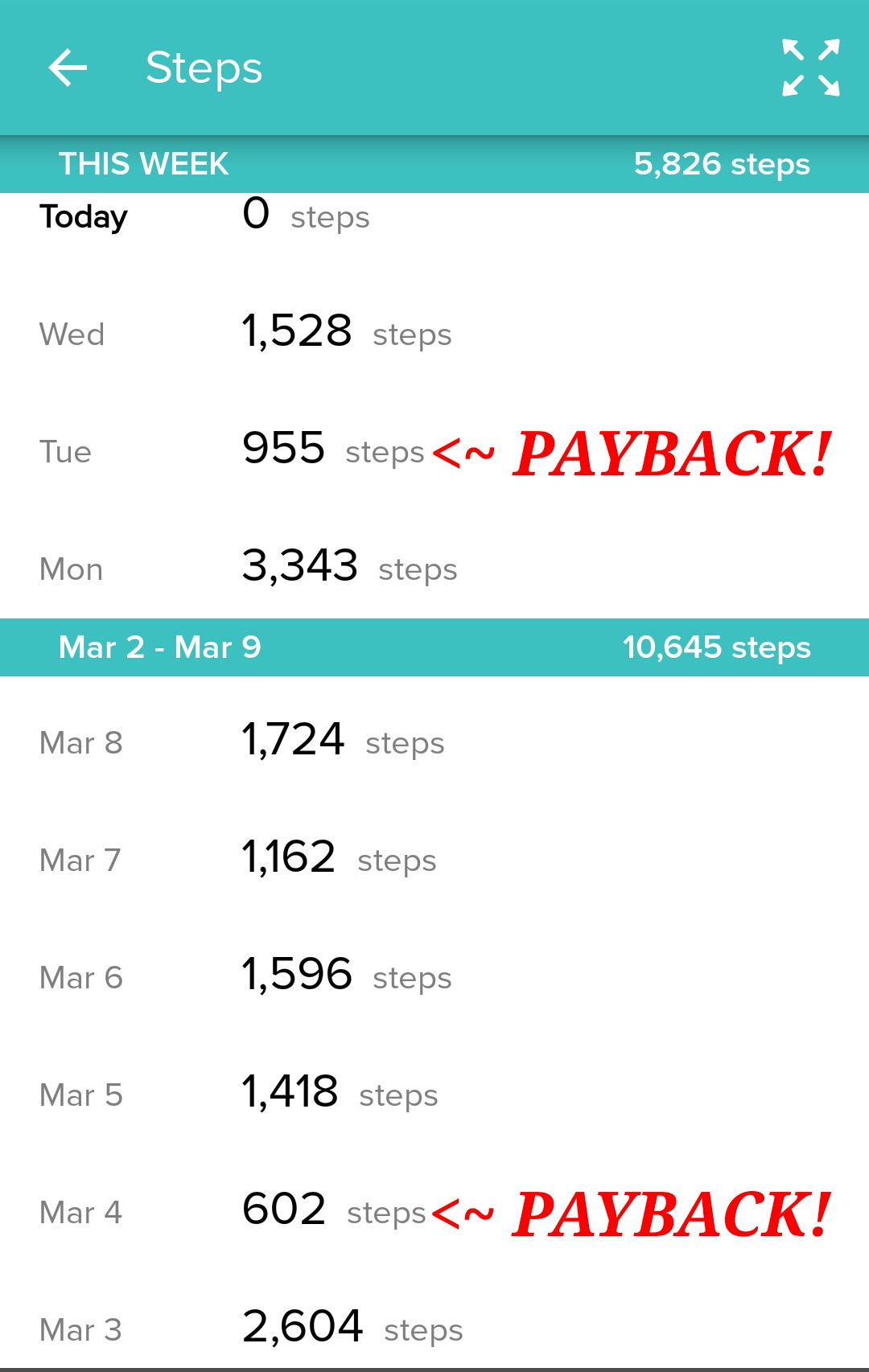
I’m averaging about 1,400 steps a day and 6 hours sleep a night. When I do sleep, my sleep has been better. I just put it together now that this might be because of the progesterone supplementation, which is meant to help restful sleep. Wow, I finally made a correlation. I still can’t wear the CPAP without all hell breaking lose and the oral appliance still wrecks my jaw, but I’m managing to get a solid 5 hours most nights, with another 1-3 tossy turny hours. I have my third sleep study tomorrow to see if the OA is helping the apnea at all. My other sleep issues (pain, night terrors, constant movement and muscle spasms, awakenings post-REM sleep) are still unresolved since I haven’t been able to tolerate the drugs offered.

My headaches have also been a bit better, maybe because I backed off the salt ever so slightly. I get doozies a few times a week, but I noticed that I didn’t really have a headache the whole time my father was here. My salt loading wasn’t helping my blood pressure at all, so I might need to be medicated.

IMG_20150104_005730

My throat spot hasn’t been itchy in a while and I think the electric shocks in my left leg have been fewer and farther between.

I stopped using the Restasis after 4 months to see if I noticed any difference and I think my eyes have been worse since stopping, but I don’t know if they’re worse enough to justify a Rx.

Sore glands in my neck, crazy tinnitus, swollen sinuses are all continuous low-key issues lately. I started taking 5-6ml of liquid Zyrtec again a few weeks ago on a whim in case anything was seasonal allergy-related. As usual, I can’t really tell anything positive or negative.

My blood sugar seems better. This could be because I’ve diversified my diet (added back many nuts, seeds, oats, goat cheese, milk, potato, corn, chickpeas) and it also helps that my new endocrinologist explained that the danger lies more in how fast my blood sugar is dropping than how low it is. This was great to hear because I have experienced those sugar crashes where it can wind up in the 40s, but I was always nervous, if, when I was going to sleep, it was 73 or something, that it would continue to plummet in the night. She reassured me that, if I don’t feel the tell-tale shakes, it’s probably ok and I don’t need to eat. Having said all that, I got out of bed this morning needing to eat right away because I was shaky and it was 63, so it’s still a delicate dance. [<~ And, after I wrote that, I had a big blood sugar crash on my way out the door to PT because I didn’t eat meat for breakfast. I had to go back inside and cook a mound of lamb and a yuca cake and eat it in the car on the way there. I was 15 minutes late. I guess hypoglycemia isn’t really any better. Gah!]

My buzzy brain and neuro symptoms are definitely still here, always incapacitating when they hit, always signalling that I need to go to bed and power down. And I’m still stiff, inflexible, pulling muscles regularly, in some pain and pretty weak. My lower back has been a major issue recently and my husband bought me a back brace that I have to wear when I’m standing in the kitchen or I’m crippled.

My mood is fine unless I’m really sick or in a lot of pain and then I’m a scared, desperate caged animal, feeling like I can’t go on another minute. When I’m really sick in bed, feeling fluish, poisoned, inflamed and broken, the dark mental cloud descends and obliterates all hope and even the very rational thought that this will ease up. I don’t forget that it has eased up in the past – seemingly, it would be easy to reassure myself that it will again, but I can’t. It’s the knowledge that I couldn’t continue living if it didn’t ease up that causes the black blanket of fear.

But enough about that…

10153765_10152436013152811_9205933814512292890_n

The last time I was out on the scooter.

The bad news is, my scooter died at the end of December. It was my one lifeline to freedom and, although I only got out on it for about an hour each month, I lived for that hour. So, I have to figure out a way to get another. The best case scenario would be one that I could lift into my car myself. The cemetery is only a few blocks away and, ideally, I’d like to go for little outings without needing my husband and his truck, since he’s not home very much. I’m also thinking about the future when I have a smaller dog and will, I hope, have the strength to walk him on a leash using the scooter. Not sure there are any scooters that disassemble to light enough parts or that I would have the energy to put in the car, drive, take out and assemble, ride around for a bit, take apart and put back in the car, drive home, take out of the car again… Now that I see that in print, it seems a Herculean and impossible task. Plus, we can’t really afford one, anyway, when we spend more than we bring in every month. When we win the lotto, we can buy a scooter and a transport van that it can drive into. Or maybe I’ll just get better.

The good news is, everything is blooming and the smells in the garden are incredible. 🙂

This took me over a week to write, so apologies if it’s disjointed. Until next time… XO

IMG_20150319_151536

Mast Cell Madness.

I’m officially terrified by my mast cells because Christmas heralded another sick, sick few days. Almost as sick as Thanksgiving, so I’d have to say the 2nd sickest night of my life. However, this time, it all started with my tongue swelling up, which gave me more insight into the mechanism behind it.

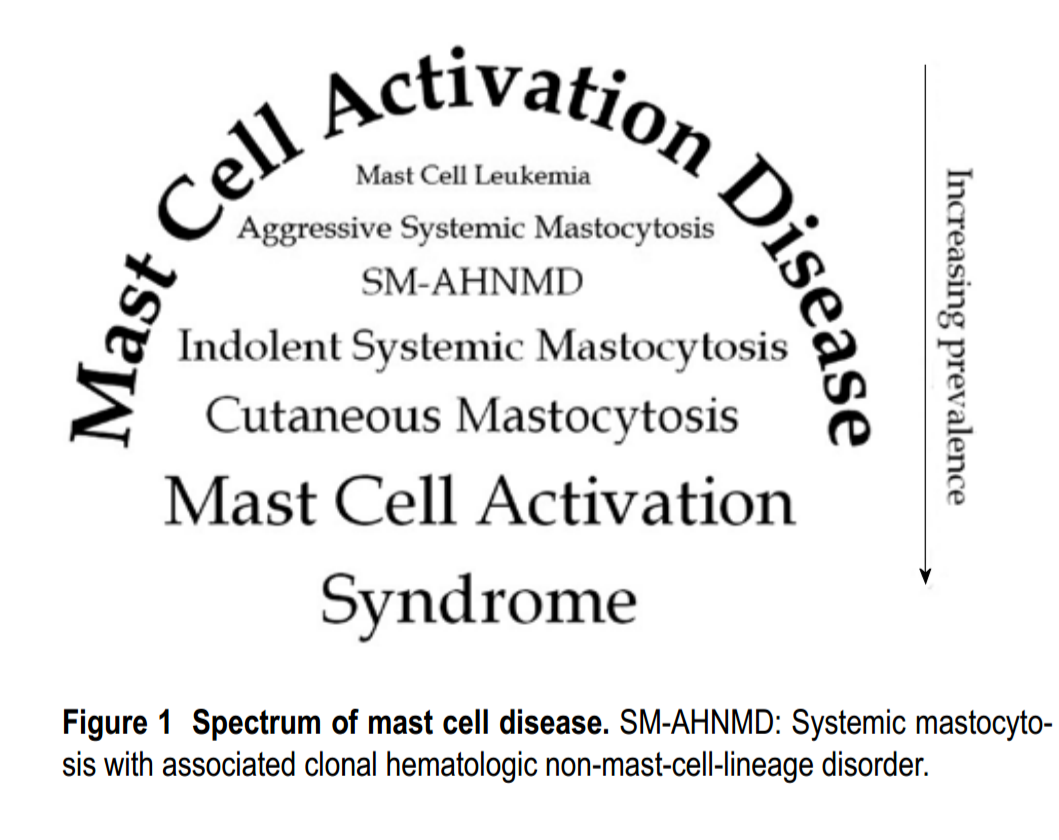
I sometimes wonder if all my health issues stem from mast cell activation syndrome. I can tell the difference between ME symptoms and mast cell reactions, but, still, there’s this little seed in my brain that says, what if they’re at the root of EVERYTHING and I should be spending my time finding a doctor with MCAD expertise on this side of the country (it doesn’t seem to exist in Seattle)? I don’t do this because I am generally stable. On a day-to-day basis, I’m not having reactions — unless, of course, many of my chronic symptoms have mast cell degranulation at their core and I just don’t realise it.

Screenshot_2014-11-15-08-21-33-1-1

My health issues started with full-blown anaphylaxis, out of the blue, 9 days after my 28th birthday. Doctors were hopeless and gave no advice back then, not even daily preventative antihistamines. The common denominator was alcohol (but not every time I drank, so it was confusing), so, after the last trip to the emergency room in Dublin, where I almost died, I finally quit drinking and haven’t touched a drop in 13 years.

Before that, I had swelling in my eyes and hands and a severe edema episode once or twice that I didn’t really think much about. I linked it to Asian food, so stopped eating that and MSG and didn’t look any further into it. This was eventually diagnosed as autoimmune urticaria and angioedema and I was told to take Zyrtec, but didn’t want to medicate daily for an intermittent condition.

I’ve always had trouble with my periods — crippling dysmenorrhea — but they got progressively worse until I collapsed with syncope and shock 13 days after my 32nd birthday and was taken off in the ambulance. For 6 years, no doctor gave me any advice until, finally, an OBGYN told me to dump salt on my tongue. This doesn’t stop the collapses, but it certainly helps. These episodes continue to happen randomly to this day, always on the first day of my period and are, without a doubt, mast cell mediated, presumably low-grade anaphylaxis (very low blood pressure and pulse, bowel problems, syncope, shortness of breath).

anaphylaxis scale

I have a spot in my throat that has itched for years. It was actually the thing that lead to diagnosis of my toxic thyroid goiters and Grave’s Disease because I mentioned the itch to some random doctor who palpated my throat. I’ve now realised it signals reactivity in my body at a very low level. It’s almost always there, but, when it’s not or when it’s very bad, I pay attention.

I was flushing badly for years, thinking I had developed bizarre self-consciousness, but the self-consciousness was actually a result from flushing and having people point it out! When I was diagnosed with Grave’s, I thought it was a symptom of that, but it never went away after ablation.

Of course, in retrospect, there have always been issues I have dealt with, which may or may not originate with mast cells: thyroid problems and Raynaud’s can be a result of mast cell disorders. Also, constipation, headaches, low blood pressure, and temperature sensitivity (all of which got much worse in recent years). Finally, many of my ME symptoms could also be from MCAS: fatigue, joint and tissue pain, eye pain, vision problems, vertigo, episodes of low body temperature, scent/odour/chemical sensitivity, sinus problems, cognitive impairment, hair loss, decreased bone density (I have osteopenia, on the cusp of osteoporosis), shortness of breath, medication reactions, malabsorption, and tinnitus. See a list of signs and symptoms here.

It would be wonderful to be able to manage and control any of these issues, but none of them scares me like the nights I’ve had recently, not even full-blown anaphylaxis. I’ve tried so hard to figure out my triggers, but they are moving targets. Tongue swelling and angioedema are obvious, as is the very specific breathing difficulty you get with anaphylaxis (it is nothing like asthma or wheezing from an infection). I don’t get daily hives and itching like many people. My reactions now are all about the histamine bucket and completely dependent on where I am in my cycle and what is happening in my life. I may be able to eat anything one week and then suspect that those same foods are giving me sinus trouble, insomnia and a jaw ache a different week. My chronic daily headaches, tinnitus, brain fog and exhaustion could be from food choices, but I’ve never been able to pin down any causation. My diet is very low-histamine compared to normal people and how it used to be, but I still allow myself chocolate, coconut, store-bought chips, beef, almost all fruit, including dried and many things that others avoid. Could these things be contributing to my problems? Yes, but, without a definite correlation, I don’t want to eliminate foods. Once you’ve experienced anaphylaxis, “reactions” like a runny nose, constipation or aching hands are quite ignorable. The only thing that consistently caused a reaction was alcohol and my periods. And, now I can say with certainty, holidays and events, no matter how careful I am.

—————————–

I prepared for Christmas over the course of a month and a half, slowly bought presents and wrapped them, slowly wrote some Christmas cards, slowly got the spare room ready for my sister, slowly did laundry — over the course of weeks! Didn’t overexert myself at all. There was no excitement, no activities. My sister and her small dog came over, we watched tv and opened presents. I had rested multiple times throughout the day and the only not normal thing I ate was half a tiny piece of fresh King salmon, which had been brought in off the docks that same morning and, I was told, caught the day before.

My tongue started to swell up after dinner. By the late evening, I had gotten upset for really no good reason (which has historically happened with my mast cell reactions) and was flushing. I had a bad reaction to about 15mg of Benadryl a week or two prior, so I was scared to take a decent dose on this night. I bit a dye-free capsule and put a drop on my swollen tongue and went to bed. At 2am, I awoke with the same evil that I experienced on Thanksgiving and the night after starting Cromolyn (before going to the AirBnb rentals back in September — it was a few days before my period that time, too). I was shaking so badly, I couldn’t lift the water glass, I was drenched in sweat and had weird runaway chills coursing through my body. I crawled on my hands and knees to the bathroom, which scared the shit out of me because, through all the worst of ME, that’s only happened once before. I fell into harrowing nightmares and woke up gasping for breath over and over, feeling poisoned and infected. I dreamt that I was sick and dying and my husband wasn’t paying attention or taking it seriously. I dreamt that I was sick and dying and my mother laughed at me (this isn’t remotely based in truth, this is my terrified mind not knowing how or where to get help). I dreamt that my dog’s neck was broken and I was carrying him to get help, but I was sick and dying and couldn’t do it. And, finally, I dreamt that I was lying on the floor begging my husband over and over: “Please kill me. Please kill me. Please kill me.” I woke up sobbing and so wrung out.

That morning, my period came 5 days early. You better believe, if I had known my period was going to arrive Christmas Day, I might have cancelled Christmas. Or at least postponed present opening for a day. And definitely not eaten even the freshest salmon.

In the past, my anaphylaxis episodes went like this:
My friend A’s birthday party.
My friend C’s birthday party.
Oktoberfest.
Easter party.
C used to joke that I was allergic to fun. I can’t believe he was right. I collapsed and had the paramedics called twice while my mother was staying with us and, also, when my best friend was here from Ireland — both were “events”. I started to get paranoid that, psychologically, I was somehow causing my system to crash when there were visitors. But, every single one of these times, I had my period. There were only a few anaphylactic episodes that I can remember when it wasn’t the first day of my menstrual cycle. EVENT + MENSTRUATION = MAST CELL MELTDOWN. But I think I only really and truly started to believe this 100% on Christmas.

So, Christmas day is a total haze. I crawled downstairs a few times to eat and try to put on a good face, but I don’t remember much and dozed most of the day. Like Thanksgiving and September, however, I bounced back quicker than I could have ever anticipated. That night I kept marveling, “How am I speaking? How am I sitting up? How am I alive?” When it’s bad, you honestly want to die. When it ebbs, the human spirit kicks back in shockingly quickly and you just get on with it, until the next time when you are surprised anew at just how bad the bad is. I didn’t even really modify my diet. I continued to eat my almond butter, coconut ice cream and drink bone broth and tea (all high-ish histamine). If anything, I felt more, Oh fuck it, how much worse could it be? At this stage, I’m much more scared of menstruation and engaging in any sort of event — even one in my house, in my pajamas, with only a single guest.

IMG_20150105_132432-1

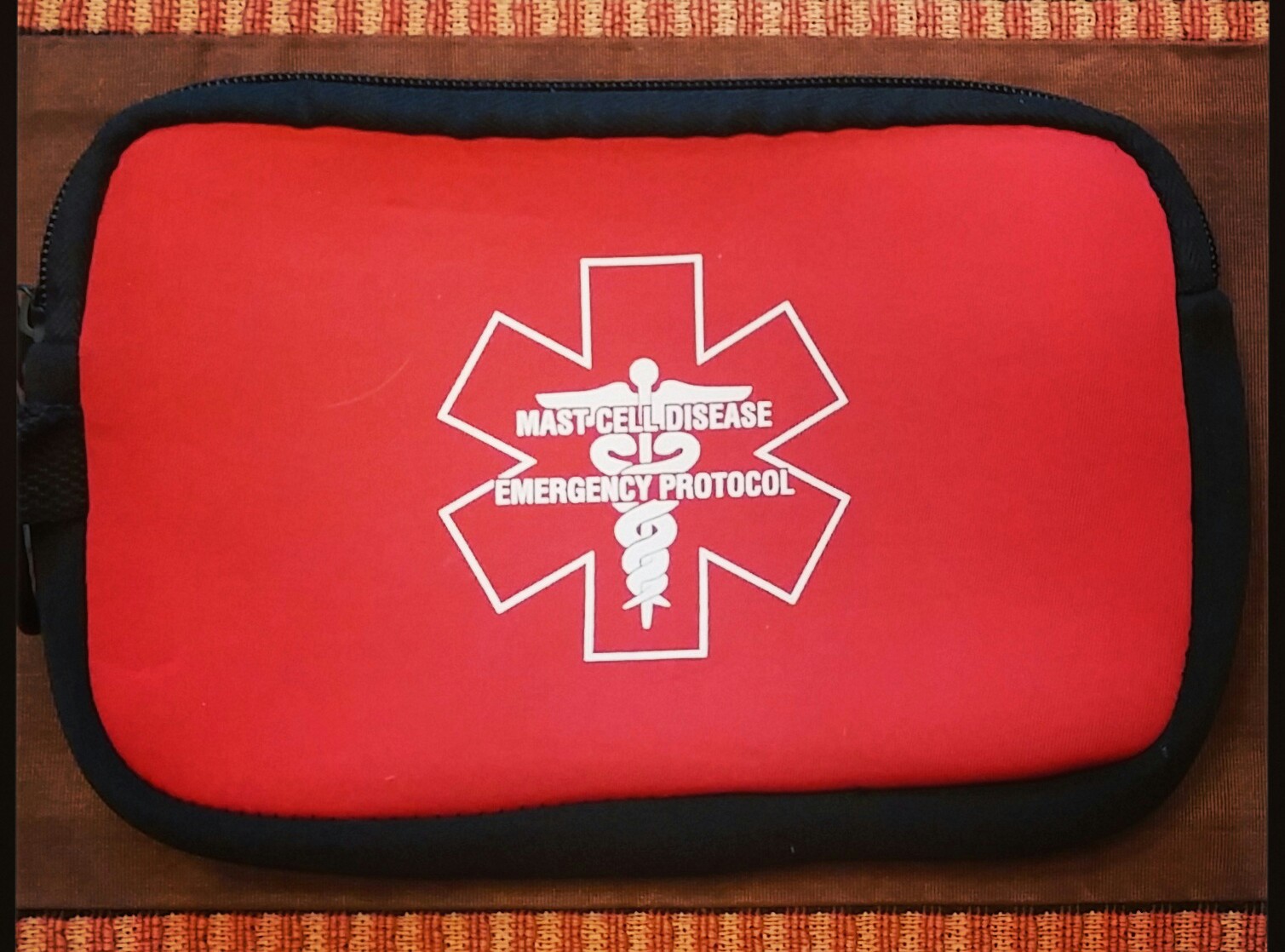
I am currently putting together an informational kit (in a bag that was donated to me by a member of one of my groups), so my husband has something to grab in the event of an emergency. My dilemma is that I’ve managed to avoid drugs all this time (never had to use my EpiPen), so I have no way to premedicate for things like plane flights, dental work or necessary procedures like a CT scan or colonoscopy (which my doctor has wanted me to get for years, but I refuse because I’m worried about reactions). I have no safe protocol. 13 years ago, I got IV diphenhydromine for anaphylaxis, now I react to 15mg of Benadryl! 5 years ago, I had IV morphine for dysmennorhea, now my breathing shuts down with a crumb of hydrocodone or codeine. What would happen in a real emergency? If I need surgery? Knock on wood, toba toba, ptooey, ptooey. Once I have everything compiled, I will post it here.

Having said all that, I’m really in quite a good place, feeling happy and hopeful about the new year. Maybe because I realise that these reactions are mast cell degranulations and not ME relapses and that takes some of the fear away. Somehow dying from anaphylaxis is less scary than becoming permanently bedbound with ME. Perhaps only people with both illnesses will understand that. So, here’s what I did New Year’s Eve:

NCM_0042_20141231005400879

Screenshot_2015-01-05-14-33-55-1

As well as resilience, forgiveness, positivity and optimism, I’d also like to request that 2015 doles out truckloads of health, wealth and happiness to all of us. That’s all. That’s not too much to ask, right? 🙂

Going to California

After two years of being housebound, only leaving my house for doctors’ appointments, never going to a friend’s house, coffee shop, grocery store or cinema, never taking a drive to look at the ocean or waterfalls or mountains, my longest excursion being a 45-minute journey to a doctor out of town, I’m going to California to see Dr. Chia.

I made the appointment months ago after rereading No Poster Girl’s advice for the newly diagnosed. I’ve seen 40 healthcare providers in Washington and really, truly feel that the only substantial help they have been is ruling out brain tumours and cancer. Countless visits, horrendous amounts of money and unimaginable energy expenditure… all wasted, unfortunately. Although, my physical therapist has helped my pain but, alas, I must stop seeing him after Monday because my private health insurance coverage ends.

I based my decision to see Dr. Chia mostly on geographical proximity, assuming that we would have to drive wherever we went. His practice is in L.A. I also considered Dr. Peterson (Reno), Dr. Kogelnik (San Francisco) and Dr. Bateman (Salt Lake City). The latter would probably be my first choice, but it seems she really isn’t taking new patients. I battled between Dr. Kogelnik and Dr. Chia, but decided on Dr. Chia mainly because I knew more about him. I have followed my friend Patrick’s experience with Dr. Chia closely, have read Christine McLaughlan’s articles on Health Rising, and have watched all of the ME/CFS Alert video interviews with him.

In a nutshell, Dr. Chia is an infectious disease specialist who believes enteroviruses are at the heart (or gut) of ME/CFS. I will never forget reading Patrick’s account of his ME onset. He said he had surfed at a dirty beach, became ill a few days later, recovered and then got the Tdap immunization and, 5 days later, crashed with ME and never recovered. I swam in a lake in Virginia, came down with a GI illness a day or two later, recovered and then got the flu vaccination and, 11 days later, had acute-onset ME. We had such similar etiologies, although, I believe Patrick was otherwise healthy and, in my case, these came on top of a plethora of other issues such as working too much, never resting, lots of dental work, lots of traveling, bronchitis, vasovagal syncope, angioedema, anaphylaxis, unknown detox issues, IBS-C blah blah blah. But I knew the diarrheal hell was the penultimate cause and the flu vaccination was the shot that broke my immune system’s back. So to speak.

I was in such bad shape last December, I didn’t think there was any chance of my being able to keep this appointment. Five months flew by and my husband and I hadn’t discussed the logistics of the trip or renting an RV or whatever (I don’t even think he knew I had made an appointment), but, before I called to cancel (because, seriously, who goes to California to see a doctor for an hour?), I asked the good people of Phoenix Rising whether they thought I should do it. They were incredibly supportive and answered with an overwhelming YES! Uh oh. Really? But, at this stage, I’d have to fly. I assumed I’d never fly again. I don’t know what a flight would do to my symptoms, let alone the whole trip. So, I asked my family what they thought and they answered with an overwhelming yes and, not only that, but they all offered to help in so many ways: come with me on the trip, stay in my home to watch the dogs, research rentals, help with money, accompany me to the appointment, donate miles for a plane ticket etc. I was flooded with love and encouragement and, suddenly, for no other reason than I wanted to ride the wave of excitement, I decided to go. If not for Dr. Chia, for me. To know that I could leave this house. To create new memories — even hard-won ones — that aren’t these four walls, this bed, this garden. The truth is, I’m terrified and I know enough about Dr. Chia’s treatments to know that it may be a one-off visit and it will probably be a dead-end. But, I’m still going to do it. And I’m going to close my eyes everyday until my departure date and envision safe travels with stable blood pressure, steady legs, no vertigo, no headaches, comfortable body temperature, no chemical or food reactions, no collapsing or swelling or bowel issues, and good sleep. I’ll write more details in my next post.