Love letter to my sons.

IMG_20160603_191259

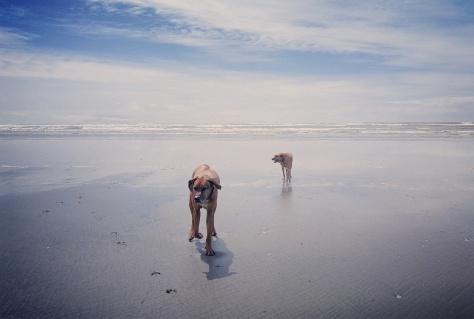
After more than 10 months, I got away from the house. Every time I look at the grey in my dogs’ muzzles, I have a panic about time slipping by and the knowledge that Bowie is hurtling towards end of life. He is 9 and Rhodesian ridgebacks typically live 10 to 12 years. Bowie is big — the tallest ridgeback I’ve encountered in the flesh or online — I fear he’s more like a small great dane and they typically live 6 to 8 years… So, I’m bracing myself. Truth be told, I’ve been bracing myself for their ends-of-life since they were kids.

Riley was originally found emaciated to the point that he couldn’t stand up and had already been in two foster homes before coming to us. We were meant to be a foster home, too, but, after he was placed with two more families that didn’t work out (and my emotional meltdown with each goodbye), we knew he was meant to be ours. And, wow, was he meant to be ours. I don’t think any other pack would have worked so perfectly. He almost died from some gastrointestinal awfulness soon after we adopted him. I watched him lie on his side, dead-eyed, weakly vomiting blood while the vet told me he thought he might not make it. Not long after that, Bowie hurt his back at the park and I lifted his 110lbs into the car with some sort of super-human mother strength and raced to the emergency vet. I was healthy then, but, still, that’s more than I weigh.
[NB: Of course I called the clinic to verify his weight at that visit.]
[NB: Of course I made sure they weren’t busy before I bothered them with that question.]

So, losing them has been at the forefront of my mind for most of their lives. It may sound morbid, but it makes me appreciate every day that they’re here and I never take a moment for granted. I will miss this hair one day, I think as I pull it out of every meal I eat. I will miss his drool one day, I say as I almost brain myself slipping in the saliva pool on the kitchen floor. I spend an inordinate amount of time cuddling them, memorising every curve and bump of their bodies, making sure I’m always conscious and grateful for their presence.

IMG_20160603_183552

I will never forget the first time I took a mobility scooter to the cemetery for a “walk” with Bowie (at the time, I didn’t trust Riley to stay close off-leash, so he went to doggy daycare instead). We had been visiting the cemetery since Bowie was a puppy, but it had been a year since I was housebound and that first year was the longest and sickest of my illness. He lept like a puppy when we got there and I wept as I watched him. I think it was as important for him to see me out as it was for me to be out. Last year, both of my dogs’ mobility declined sharply. Riley is arthritic and Bowie is an old, creaky man. My number 2 wish (after getting better) is to fill their time with as much fun as possible. If I could, I would take them someplace different every day, wear them out, introduce them to novel smells and new friends (every time I’m flabbergasted or frustrated by my acute sense of smell, I think what the world must be like for a dog whose nose is tens of thousands of times as sensitive as a human’s. While a dog’s brain is only 1/10 the size of a human brain, the part that controls smell is 40 times larger. Can you fathom that even slightly? Whenever I see someone yanking on a dog’s leash, I think, imagine what he is smelling down there! Give him a minute!).

My dogs are my kids, my caretakers, my comedy, my inspiration, my reason for pushing myself, my main source of joy.

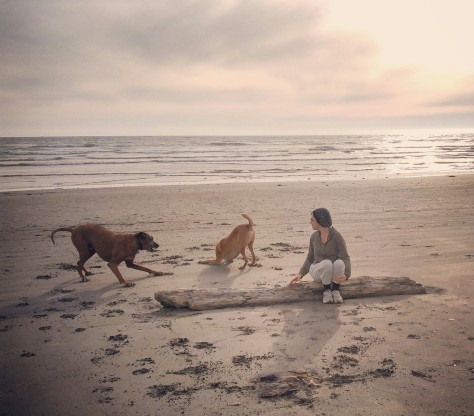
So, this is all a big preamble (pre-ramble, more like) to the story of our recent road trip to the coast (in a future post) and why it was so important to me. I can’t fly with my dogs to India or Africa or even to different parks very often, but once a year for the last 3 years, we’ve made it to the seaside. This time was different, though. This time I was stronger, I wasn’t as crushed by poisoned pain and my husband and I were happier, not desperately grappling for handfuls of different memories within the blind freefall of sudden severe illness survival. Because that’s what it has felt like: an initial period of confusion, fear and searching, followed by 3+ light-speed years of gasping for air and kicking like mad to keep our heads above water, learning how to navigate this life. And in all that time, it’s felt like we both had faces bowed down in grimaces of pain or duty, grief or worry, eyes meeting fleetingly, but blinded by our separate burdens. So, I remember those previous journeys to the ocean as a bit desperate, slightly lonely and only partially successful. But this time was different. Not easy, not perfect, but more like real life. Like a life where I’m totally present with my husband and easily walking the beach with my sons. I’ll get there one day.
IMG_20160601_130740-1

Grab that cash with both hands and make a stash.

This is a hard one to talk about. It’ll be more of a rant. And I’d like to preface it with all of the obvious about how grateful I am that we were in the economic position we were in when this illness started, how grateful I am that I had a few years of good earnings and decent savings, how grateful I am that my family is healthy and has never been bankrupted by health woes. I am, I truly am, and I think about–probably too much–what must happen to others with a severe chronic illness (that has no knowledgeable doctors and no decent treatment) who are in worse financial shape than we are, without our resources, who are in countries steeped in poverty, refugees fleeing wars… on and on… I do know how lucky I am. But, I’m scared. Mostly because I don’t know what treatment to spend money on and what to reject.

image

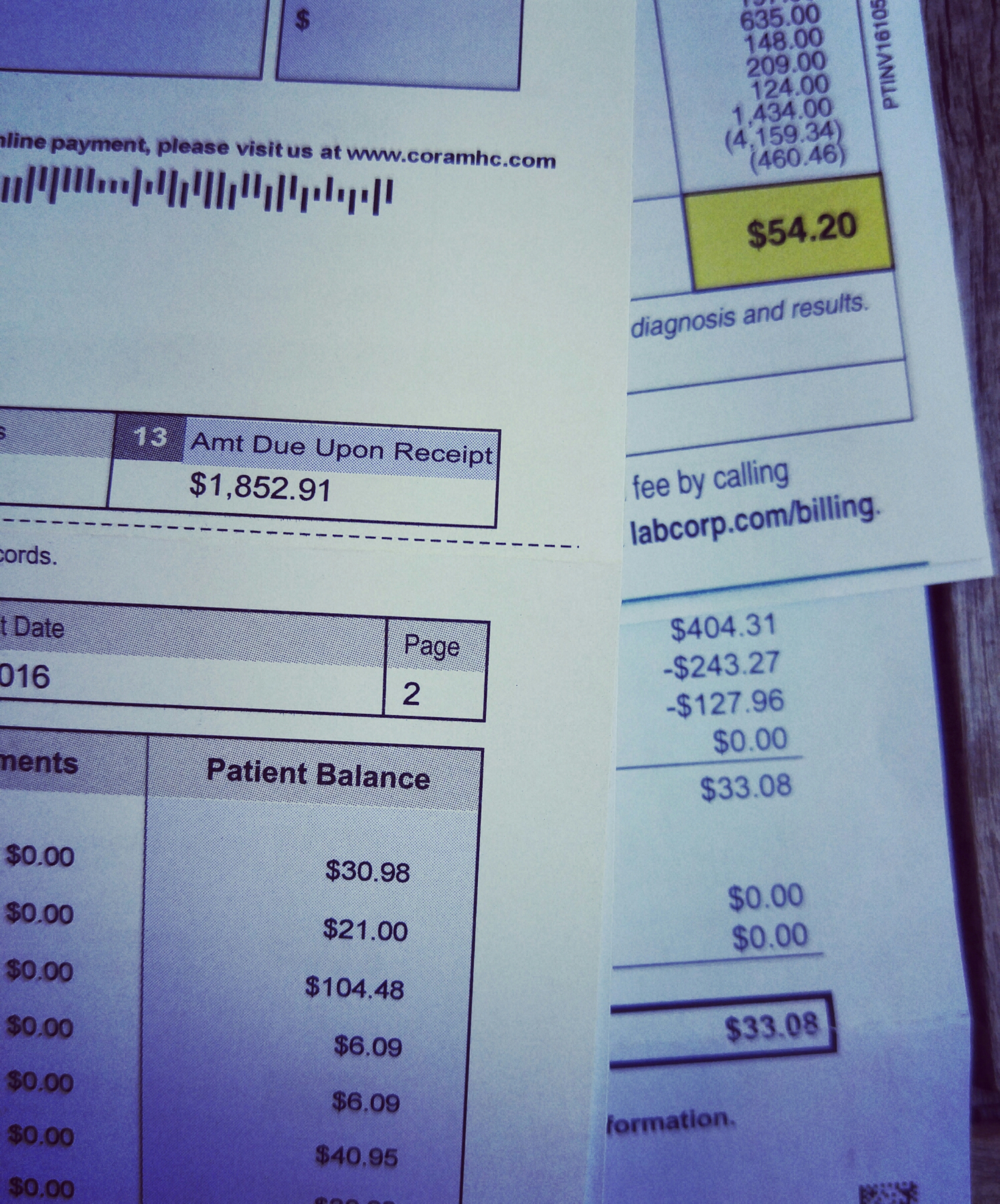
Recently, after 6 months of immunoglobulin infusions, I got a slew of bills that I didn’t anticipate. It turns out that for my itsy bitsy dose of 5 grams each week, I pay $164 after insurance. Out-of-pocket. That’s $655 per month. If I had known this before starting, would I have done it? I don’t know. But now that this is the only treatment that has helped me, how can I stop? And I’m in this tricky spot. I have private health insurance because I was too scared Medicare wouldn’t cover these treatments (also because Medicare won’t cover acupuncture, nutritionists or physical/myofascial/craniosacral/massage therapy — some of the only things that have made a difference in my pain levels). After being told IVIG was not an option by so many doctors, knowing that I didn’t have a history of bacterial infections and a vaccine challenge is usually required for approval, and having Coram (the infusion service) tell me that Medicare hardly ever covers treatment, I was just too scared to give up the private health insurance that had already approved my treatment for the whole year. Of course, I have since heard from others that Medicare covers their IVIG or SCIG at 100%, but … how could I risk changing coverage now when my IgG levels have come up and that alone might disqualify me from continued treatment? I’ll have to revisit this next January when I’m eligible for Medicare enrollment again, but, if I’m still improving with my infusions, I don’t know how I’d take that leap of faith.

An aside for those in other countries or for those that don’t know this fucked up aspect of our healthcare system here in the U.S.: Medicare (government health coverage) isn’t free. You pay each month just as you do with private health insurance. It’s usually cheaper, but not always. It can range from $105-$771 a month, depending on your situation (the higher end is reserved for people who have not worked enough in their lifetimes to qualify. So, if you are struck down with a chronic illness as a young adult and you haven’t worked the requisite 30 quarters in a tax-paying job, you’re not married and you undoubtedly have little savings, then you get to pay the highest premium for our national health coverage– oh, but only if you’re lucky enough to be granted full disability, which very few ME/CFS/Lyme sufferers are). And don’t think that Medicare actually covers your healthcare in full, though. You will still have a deductible each year and co-insurance (the patient pays 20%, typically), you’re prescription medications aren’t paid for unless you get extra coverage and hospital stays can still leave you in horrendous debt. You can stay in a hospital for a few months for the low, low price of $1,260 (although skilled nursing facilities will be more because that price doesn’t cover people to care for you), but let’s take a pretty terrible example: 150 days in the hospital. In 2015, that would have cost you $47,565 out-of-pocket. If you had to stay any longer, all additional costs are your problem. The government washes its hands of you. But wait, there’s more! If you choose not to enroll in Medicare when you become eligible, your monthly payment when you do enroll will be higher–forever–usually 10% higher for each year you could have signed up but didn’t. In my case, if I’m covered by Medicare next year, I will be paying an extra $300/year because I didn’t enroll when I first became eligible. If I wait until 2018, I’ll pay a penalty of at least $440 that year, plus more each year as the premiums continue to rise over my lifetime. Lovely.

SO… Last month I finished up weeks of financial slog for our 2015 taxes and was happy to see our (and by our, I mean my because my husband’s medical expenses are only about a quarter of our total and that is solely health insurance premiums because he never needs a doctor, knock on wood, toba toba) out-of-pocket medical costs had come down slightly.

2012: $14,480
2013: $19,032
2014: $19,564
2015: $17,912

That doesn’t allay the fear, however. After utilities (sewer, water, garbage, recycling, gas, electricity) and mortgage payments, we’re left with about $20K a year to live on and medical expenses have been almost $20K a year since I got sick. That means most everything else–food, clothes, toiletries, dogs, phone, internet, gas for cars– comes out of our savings. I’m trying to be healthier, place fewer burdens on my system and subdue my chemical sensitivities by eating organic food, pastured meat and buying less toxic products. All of these things are more expensive. For the last year and a half, I’ve been paying $200/month for compounded medications instead of the cheap, generic, filler-filled ones. It hardly costs anything to get sick, but the system is rigged to bankrupt those that are.

I feel very fortunate that we had saved money before this happened, but it will run out eventually and I don’t want to make all the wrong decisions now because I’m frozen in fear of the future. Our day-to-day living is all-encompassing, so time slips by in survival mode and the big decisions never get discussed. I’m happy that we didn’t sell the house when I first got sick because we’re finally not under water and it might actually be worth what we owe again. But when do we sell? And do I switch back to generic meds? Do I stop supplements (around $100/month)? Do I stop seeing my doctor who doesn’t take health insurance? Do I not try human growth hormone or hyperbaric oxygen or nutritional IVs? Do I stop my immunoglobulin infusions?? Last year, I thought a time would come when we just moved somewhere very small and affordable, maybe a foreign country, and I stopped all medical visits and we tried to exist on pittance and make our money last as long as possible… But now that I’ve found a treatment that helps my functioning, I have renewed hope. Maybe I’ll be able to earn a living again if I keep making progress. How can I give up on that? Or should I accept the fact that this is as good as it’s going to get, income-wise? My husband will get older, he’ll be able to work his manual-labour job less and less and I won’t ever recover to the point of being able to hold a job… I think that’s the reality. I know a lot of people with this illness and many have made improvements, but I’m not sure if I know any that have gone back to full-time work.

So, we beat on, boats against the current, cut costs where we can, shop the deals online, grow some veggies, sell some stuff, and pray that in ten years time, the tides have changed for the better.

Title Credit

International Awareness Day for Myalgic Encephalomyelitis

Posted on Facebook:

Today is International Awareness Day for Myalgic Encephalomyelitis (ME/CFS) and this is my small effort to educate and contribute to a larger understanding of this disease. Like I said last year, there’s not much point in continuously sharing information within the patient community, since we know the hardships all too well, so I’m asking my healthy friends to take a minute to learn a bit more about this debilitating neuroimmune condition. Only with awareness can the tides change.

Like many illnesses, there is a large range of disability. Some people can hold jobs, while the severe end of the spectrum is horrific incapacitation*. Unlike other illnesses, however, there is virtually no budget for research (male pattern baldness has 6 times the funds devoted to discovering treatments, according to Dr. Klimas).

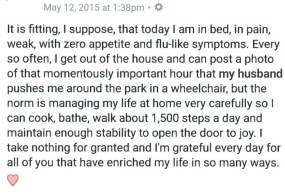
274c75c7-e926-442c-947c-68e020e95d2b-1-1In my own case, I have made a lot of improvement since starting immunoglobulin infusions 7 months ago. Facebook reminds me that this time last year I was bedbound, in pain, with flu-like symptoms, which still happens, but with much less frequency. Things are more stable, payback isn’t as vicious. I still use a mobility scooter in the dog park, but I have more than doubled my daily steps and I’m able to do more. Today I went to the bank. 🙂


More information:

Jen Brea on TED Blog
Occupy CFS: Very Very Aware
Learning to Live With ME/CFS: Today is International ME/CFS Awareness Day

How you can help:

On May 26th, MEAction has organised the #MillionsMissing project, which will take place in multiple cities across the world, with a coordinated campaign of demonstrations and demands. Learn how you can support it here.

Sign this petition to increase funding to find a cure.

There is very little funding for research for treatments, so, if you have the inclination and means, donations are sorely needed:

U.S: Open Medicine Foundation
U.K: Invest in ME

In the U.S:
Tell Congress to Increase Funding for ME Research.
Send your congressional rep Llewellyn King’s article on The Hill’s “Congress Blog”.
Buy a “Congressional pack“.

*More info on severe M.E.:
Severe M.E. and Invisible Illness Video
JK Rowbory: All the things that you never wanted to know about my life with an acute chronic illness

Plants that clean indoor air.

I just made this list for myself, so I thought I’d share.

Based on studies done by NASA  and others, these two plants filter the most chemicals from indoor air. They help rid your home of benzene, formaldehyde, trichloroethylene, xylene, toluene and ammonia:

Peace lily (Spathiphyllum‘ Mauna Loa’)
image

Florist’s chrysanthemum (Chrysanthemum morifolium)
image

These next three plants filter all of the above except ammonia:

English ivy (Hedera helix)
image

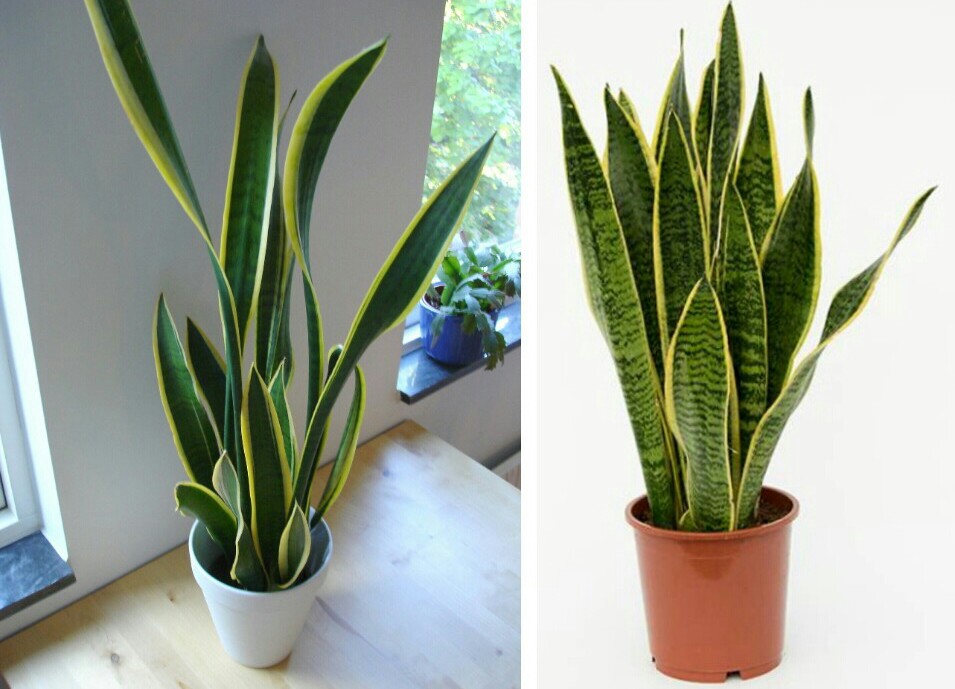
Variegated snake plant, also called mother-in-law’s tongue (Sansevieria trifasciata‘ Laurentii’)
image

Red-edged dracaena (Dracaena marginata)
image

All of the above plants are toxic to dogs and cats. For nontoxic options, try Lilyturf (Liriope spicata) or Broadleaf lady palm (Rhapis excelsa), which filter formaldehyde, xylene, toluene and ammonia, or Barberton daisy (Gerbera jamesonii), which filters benzene, formaldehyde and trichloroethylene.

NASA recommends 1 potted plant per 100 square feet of indoor space. Here’s a 2009 TED talk on the subject. For more plant options, check out this table.

Crutch

This morning, I’m without internet for perhaps the first time since being housebound and I’m embarrassingly out-of-sorts. I’m online doing something pretty much all day. Whether it’s reading articles, talking with people on WhatsApp, ordering things I need, paying bills, connecting with the outside world on Facebook, streaming shows to our TV, podcasts, music– it all requires an internet connection. My calendar is online, my to-do lists are online, my newspapers are online, I have commitments with a neighbourhood group and we communicate solely via FB Messenger, Skype is down and I don’t have international calling on my phone… It even took me a while to figure out how to type this because I don’t have a laptop with Word and I usually just open an email to write blog posts.

I realise this is a privileged problem–I’m not complaining about the internet being down, I’m complaining about how dependent on it I have become, how empty my daily routine is without the World Wide Web. But empty is an ugly word–how open and full of possibilities my day is without my crutch. And just how incredibly grateful I am for that crutch. If I were too sick to look at a screen or be near wi-fi, or if I had gotten sick years before I did, this would have been a far more harrowing and isolated experience. The internet has told me what doctors couldn’t, my symptoms are less scary and things are put in perspective, I’ve made wonderful new friends, stayed connected with some old friends and traveled the world with them through photos online. But today I might do exactly what I longed to do when I was a workaholic — laze at home and read a book. Pity I already feel antsy and am losing focus one page in. My brain needs some serious retraining.

Title Credit (when I was trying to decide what to call this short post, I realised it would be an excellent opportunity to share Ren’s new song, featuring his girlfriend. He is someone I know online who suffers with M.E. and Lyme disease. He is also an incredible musician. This song brought tears to my eyes (of course, it’s not about the silly interent, it is about the much more important crutches in our lives–our loved ones).)