IV saline experiment… causes angioedema and histamine release.

I had a total meltdown yesterday. As my throat grew more swollen and I grew more alarmed, I finally put it together that I was experiencing an acute angioedema episode. I didn’t recognise what was going on because I usually get a swollen tongue and lips. On Friday, I chalked the edema up to fluid retention from the saline. The spot deep in my throat under my jaw that I mentioned in my last post always itches when I am having an allergic reaction – it’s the canary in the coalmine of my body – but I don’t pay attention to it as closely as I should. This was a slow cooking reaction: laboured breathing and swollen eyes, fingers and sinuses (stuffy nose) on Friday evening, itchy throat spot and heart skipping/arrhythmia started Saturday (both continue today, Tuesday), flushing/extreme overheating on Sunday, and throat closing on Monday, coupled with what felt like body edema – swollen bowel, abdomen, muscles…

Now I know throat closing/laryngeal swelling calls for me to use my Epipen, but, like I said, I didn’t cop on to what was happening until late in the game. Also, I would really have to be on death’s door to voluntarily inject myself with epinephrine. But I was very, very scared. Hence, the meltdown. I actually said to my husband, “Why can’t I just have a peanut allergy – something I can try to avoid?” I actually said, “Why can’t I JUST have M.E.?!” I don’t say those words lightly and, of course, if I could barter away my illnesses, ME would be the first one to go, but it is terrifying to feel like you have no control over anything and living with the threat of a fatal allergic reaction that can’t be identified is the ultimate loss of control.

I’m too tired to explain thoroughly and scientifically, but, basically, angioedema is the same mechanism in the body as urticaria, only in deeper tissues. If it happens in the tongue and throat and lungs, it can kill you. Often, as in my case, there are no identifiable triggers, so you just deal with it when it happens and hope it isn’t serious. It can present with urticaria or without and it can be as severe as anaphylaxis or very mild. If you want to learn more, Medscape has a very comprehensive set of articles (many tabs at the top with many pages per tab- just click on the next page at the bottom and you will go through them all). All of the better information on these types of conditions is relatively new. When I was diagnosed with idiopathic anaphylaxis 12 years ago, blood tests turned up no allergies, so the doctors washed their hands of me. That was it. When I suggested alcohol as a possible culprit, the doctor was disdainful and dismissive. When I mentioned that most times this happened was during my menstrual cycle, I was ignored. Here’s an Epipen, go away. Nobody knew about mast cell activation or histamine intolerance. And, of course, I was right! With my limited knowledge at the time of all things medical, I came up with the common denominators that made sense: booze, period, ibuprofen.

For an excellent article read this:
“The ingestion of histamine-rich food or of alcohol or drugs that release histamine or block DAO may provoke diarrhea, headache, rhinoconjunctival symptoms, asthma, hypotension, arrhythmia, urticaria, pruritus, flushing, and other conditions in patients with histamine intolerance.”

A few years ago, when I was diagnosed with autoimmune urticaria and angioedema and the doctor warned me (2 years too late) that people with this condition are more likely to have autoimmune thyroid disease, I asked him why the doctors years ago hadn’t looked into this autoimmune component. He said it was unknown then. He said it was something that only recently came to light. The only other thing he suggested was prophylactic treatment with Zyrtec, which I half-heartedly tried for a few months. No mention of H2 antihistamines or mast cell stabilizers. No mention of H3 or H4 or diamine oxidase. No discussion of mast cell activation, mastocytosis, histamine intolerance, low-histamine diet or any tests – whether reliable or not. No interest in looking into acquired angioedema, bradykinin-mediated angioedema or estrogen-dependent angioedema, all of which don’t respond to antihistamines. So, all of us – the patients – are scrambling along the edges of science. I feel like a surfer on an excruciatingly slow-moving wave. I come up with theories and do my own research and I see it mirrored in others’ blogs, but no doctors are accessible to help and no tests are robust enough to firmly diagnose.

For an excellent summary from another ME-afflicted blogger with mast cell problems (as well as EDS), read Jak’s blog: Mast Cells & Collagen Behaving Badly.

Which brings me back to my meltdown. For the most part it was a silent, immobile and tearless meltdown. I was simply frozen with fear. Saline probably caused a massive histamine release – right in the middle of my low-histamine diet experiment. I brought this situation on myself by requesting the saline. I had a reaction to an innocuous substance that is used to treat allergic reactions! Just like I had reactions to the antihistamines that are used to treat allergic reactions.

I can’t live with ME and angioedema and histamine/mast cell issues and sleep apnea and thyroid disease and crippling periods and a headache that never goes away and reactions to so many drugs!!

Fear of my throat closing more while I slept, fear of sleeping without my CPAP, fear of being woken up constantly by my CPAP, fear of taking an antihistamine, fear of not taking an antihistamine, fear of eating things that cause inflammation or histamine release, fear of losing more weight, fear of being on the pill, fear of having to weather my periods off the pill, fear of living the rest of my life in pain, fear of being in so much pain I have no choice but to take painkillers. What if I break a bone? What if I’m in a car accident? And then, swiftly on the heals of that thought, the fear that sent me into a tailspin: What if I have to go to the hospital? IV saline… IV painkillers… IV Benadryl… Contrast dye… Anesthesia… Surgery… What do I do when I’m older and I can’t avoid some procedure? When I break an already-osteoarthritic hip? What do I do if my body reacts to everything? I’m dead.

Fear of dying. Fear of living in this fear.

My answer to all of it was to throw caution to the wind and eat a bunch of forbidden histamine foods.

This is a perfect segue into part II of my diet post. I realise you are all on tenterhooks waiting to read it, but not yet, not yet.

_____________________________
The most recent article describing IA (idiopathic anaphylaxis), written by Karen Hsu Blatman and Leslie C. Grammer, explains the distinction this way:

Patients with IA-A experience urticaria or angioedema with upper airway compromise such as laryngeal edema, severe pharyngeal edema or massive tongue swelling without other signs of systemic anaphylaxis. Patients with IA-G suffer from urticaria or angioedema with bronchospasm, hypotension, syncope, or gastrointestinal symptoms with or without upper airway compromise. Reference.
Throwback Thursday: Autoimmune Thyroid Disease

I have had an itch under my jaw, deep in the tissue of my neck for years. In 2009, I decided to mention it to a doctor one day and, although she didn’t feel anything abnormal in the area of the itch, she did casually say, “You do have a lump on your thyroid, though.” I had a thyroid nuclear test done and a radioactive iodine uptake test which showed two toxic multinodular goiters.”Toxic”, meaning thyroid hormone was being produced at an increased rate, which is why my thyroid stimulating hormone (TSH) tested so low. “Multinodular” because it was a late-stage goiter, meaning it had been around for a while and had a chance to grow and become lumpy. In my case, I had been hyperthyroid for at least 7 years ~ my first abnormal TSH result was in 2002, but my doctors never pursued it and I didn’t know enough to insist.

This was my first experience with specialists. I had only ever dealt with general practitioners and emergency room doctors. The research doctors that diagnosed me were bizarre. They came into the room and peered at me like I was a specimen, their faces frozen into pensive seriousness. I started cracking jokes to break the tension, but they didn’t respond in kind. They asked me questions with long quiet pauses in between, during which they would look at each other and mumble and nod: Do you have flushing? Are you intolerant to heat? Do you shake? Stick out your tongue. Hold out your hand. Have you experienced any anxiety symptoms?  I finally stopped them and asked what they had found ~ they had told me nothing! Do I have cancer? No. Do I need surgery? No. Okay, now you can ask me more questions.

I had to do both nuclear medicine tests twice because too much time elapsed from my first round of testing to go forward with treatment ~ radioiodine ablation. After you have radiation treatment, you must stay away from people and animals for a few weeks, use different cutlery, use a different toilet and/or flush twice. It seemed like a big decision, but the doctors told me it was a terminal problem. I’ll never forget that. They said there wasn’t a very long life expectancy for people with untreated hyperthyroidism. Huh? Seriously? I didn’t seem to have a choice. So, I did it. I killed the whole thyroid and started taking hormones every day for the rest of my life. I never missed a day of work through this experience. During the segregation weeks, I holed up in the restaurant office, alone. I remember encountering a pregnant lady on my way to the rarely-used toilet in the basement and leaping back out of her space as if I’d been electrocuted… high-tailing back into the office so she wouldn’t be exposed to radiation. What must she have thought? 😉

Interestingly, I never felt like the symptoms abated. The flushing and hot flashes (my most visible symptoms, which I chalked up to oddly increasing self-consciousness) and the anxiety (which I blamed on my job) ebbed a little, but not much. And, of course, this was undoubtedly part of the priming of my body for ME. Hyperthyroidism and my anaphylactic episodes started about the same time. It was the beginning of the end.

Below are the photos and email that I sent to friends and family back then, hoping that it might open someone’s eyes to thyroid problems or make them listen a little bit more to their bodies. The fact that I thought I was having “devastating” and “debilitating” symptoms then strikes me as funny now… and sad. What was happening to my body because of my thyroid problems was NOTHING compared to what is happening to my body with M.E. They’re not even on the same planet … in the same universe. Can’t I go back to my old serious  health problems?

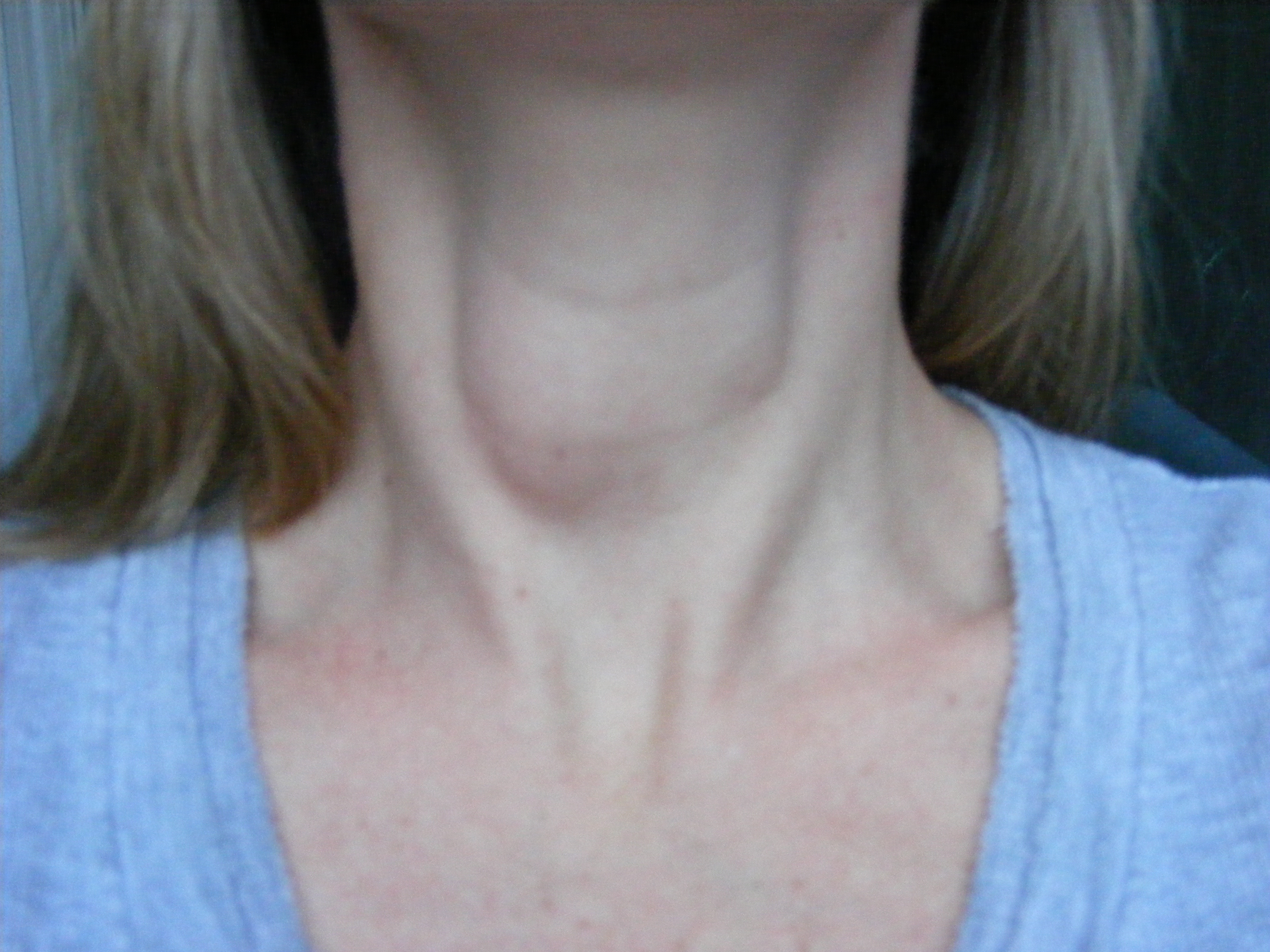
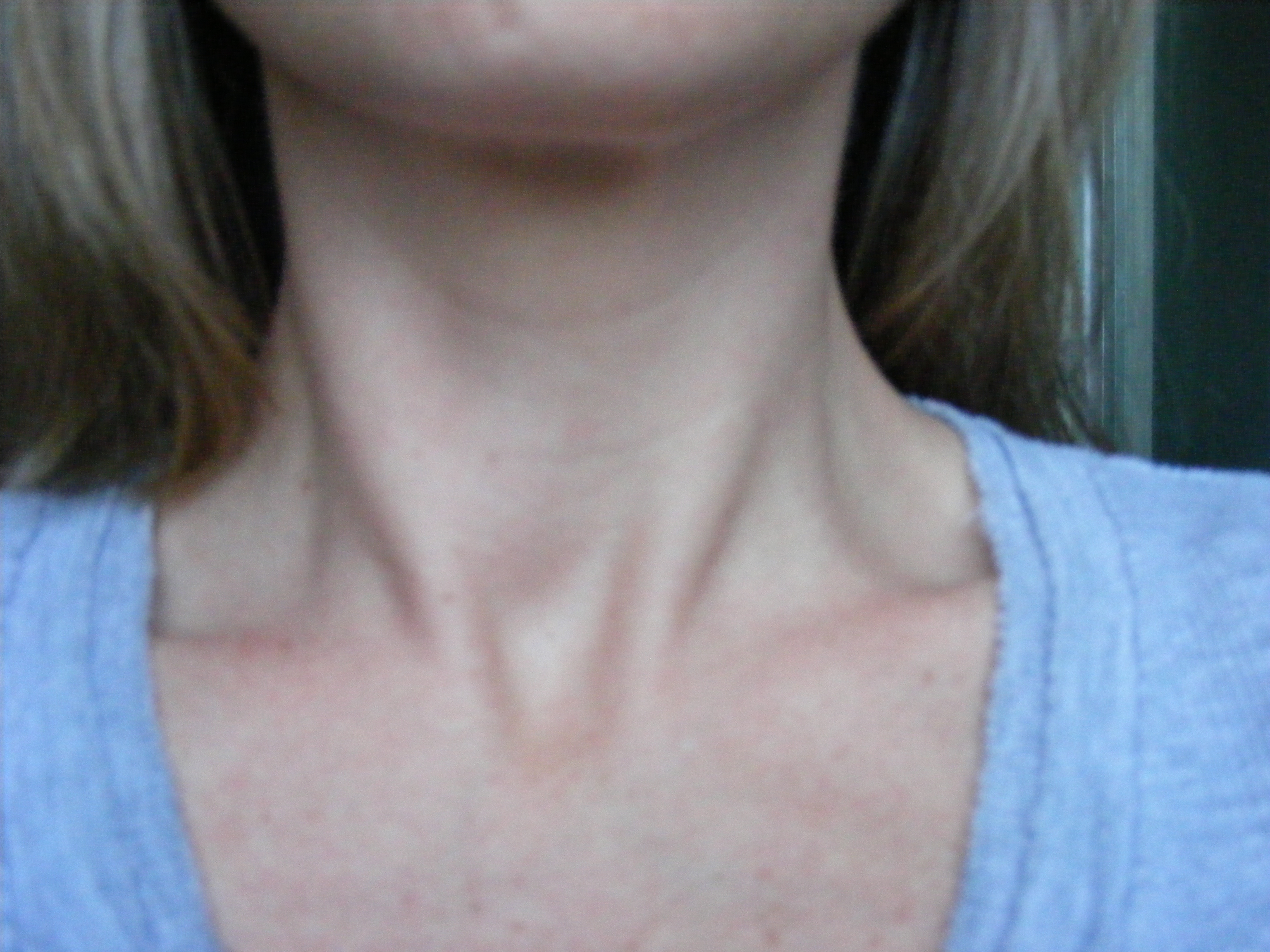
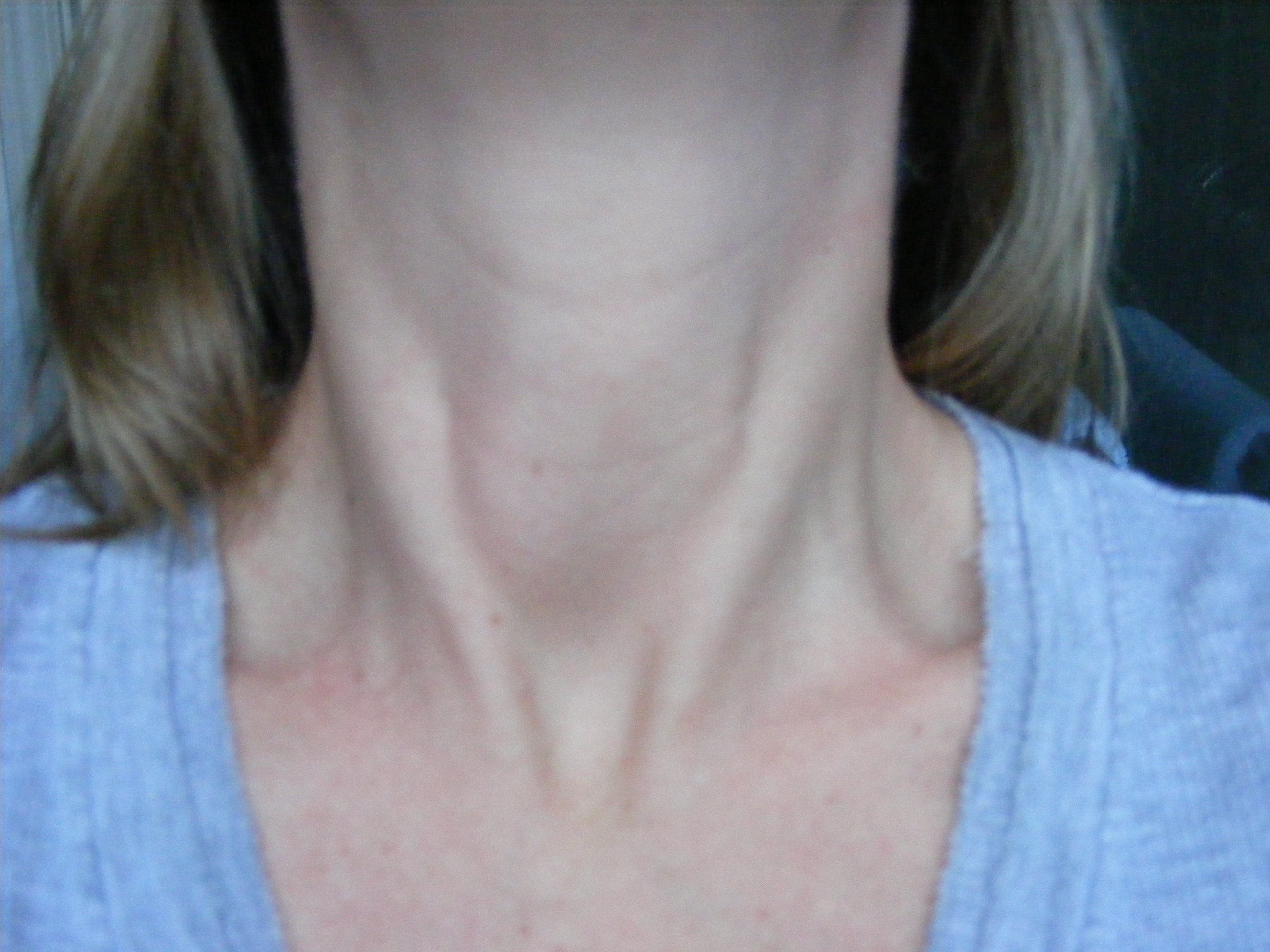
I have attached 3 pictures that I took before I got radiation treatment (ablation). The first is looking at my neck as I stand relaxed, the next is with my head back and the third was taken as I swallowed. I can’t believe I never noticed the lump on my thyroid. I can’t believe nobody else did. I can’t believe, with 7+ years of abnormal TSH (thyroid stimulating hormone) levels, neither a doctor nor I, myself, looked any closer at my neck or my symptoms.  [The radioiodine must have swelled my thyroid, however there was definitely a visible lump before treatment that I never noticed until it was pointed out -and it is unforgivable that no doctor ever took the time to look further into my bloodwork or palpate my throat.]

straight on

Head straight on.

So, I guess I’m hoping this email influences everyone to pay closer attention to their bodies. Look closer: know every line and lump so you’ll recognise changes. Listen closer: if your body is constantly telling you it’s way too hot or way too cold or way too tired or way too hungry, don’t ignore it. Don’t wait for a doctor to find out what’s wrong with you ~ question everything that feels wrong.

It turns out I wasn’t overheated & flushing because I’d become suddenly self-conscious. It turns out I didn’t just “get lucky” with an amazing metabolism. I wasn’t having floods of anxiety that caused my heart to race & skip beats because my job was stressful. I wasn’t debilitatingly exhausted because I worked too much & didn’t sleep enough. Well, at least not entirely.

head back

Head tilted back.

It’s still going to be a long road ~ my doctors say we could be tweaking my medication for years. I still vacillate between feeling ok and feeling dizzy and wasted… I eat about half what I used to… I’ll have to take hormones forever…. But, it’s not out of the question to go to a movie after a day’s work and I don’t spend my weekends crumpled in a ball, sobbing, asking what’s wrong with me while my husband wonders what to say….

I’m angry that I spent so long feeling that way and just explaining it away. I hope this inspires everyone to take a minute to think about your body and your quality of life. It’s all too short! Take care of yourselves!

swallow

Swallowing.

Surgery and ME/CFS

After two weeks of wonderful, solid sleep with few awakenings, I was beginning to see the light. Over the long weekend I started to feel more normal than I have felt in months ~ maybe a year. I could do so much more during the day and I was still feeling alright before bed. I didn’t have any periods of utter exhaustion or flu-type feelings and my brain was firing on more than one cylinder (not all cylinders, but obviously more than usual). My physical therapist and I always talk about movies, tv shows, music and books and I can never come up with names or titles: “Oh, you should read… I can’t think of the name… it’s written by what’shisname… you know, the American guy that was living in England…” I get so frustrated. There have been many times I wish I could text him after I get home and can look up the ten things I was reaching for. Yesterday, my brain was a smooth operation. It truly felt like somebody had lubricated the synapses. There was a sense of physical spaciousness. It was a well-oiled, humming machine, almost like my healthy days. “Edward Norton was great in Primal Fear. I loved him in American History X… Yes, I adore Kevin Spacey. He was so good in American Beauty. And Seven! Oh, and the David Mamet play… Glengarry Glen Ross ~ so good! And Swimming with Sharks. I’d love to be able to see him in Iceman Cometh on stage…” All those names! They just came to me! No searching, no hard grinding mental gears, no giving up in frustration. It just illustrated the limits with which I’ve been living.

Anyway, last night I didn’t sleep and I feel dreadful today and my head hurts and my brain hurts and I fear the worst for a downhill turn. I got 4 very broken, very uncomfortable hours of sleep because, in the middle of the night, I woke up with a terrible pain in my abdomen. It is a recurrent sharp stabbing in the upper right quadrant, which has me grimacing and sucking in air every few minutes, trying not to gasp or moan so my dog doesn’t panic (which he does when I’m in pain). Throughout the night, I did everything I could think of: walked, sat, breathing exercises, massaged, drank water… Nothing helped and it is still with me now, nine hours later and definitely has me worried. I assumed it is a issue in my bowel because that is where all my problems lie, but I spent the night lying in the dark quiet, worrying that is my appendix (also, I had a bowel movement and nothing changed). I’m not vomiting and I don’t think I have a fever, so I’m not jumping to see a doctor. But the pain hasn’t dulled at all and I am so, so tired. If it continues into tonight, I won’t get any sleep again.

As I lay there last night, I was tormented by the thought that it would suddenly get more serious and I would need surgery for something. I thought about all the info that I would want doctors and anesthesiologists to know in an emergency situation and decided I had to get up and write a doc that my husband could produce if I were incapacitated. Below is what I put together and I thought it might help someone out there. I wrote my own list and, afterwards, I read Dr. Cheney’s and Dr. Lapp’s advice online (to make my list more thorough) and it is incredible how closely I fit the ME/CFS mold. After two years it still amazes me when my health history PRE-ME fits all the symptoms and idiosyncrasies. For example, vasodilators are problematic to ME patients and I already knew this was a problem for me before becoming sick because of my history with idiopathic anaphylaxis and alcohol causing collapse. Also, the doctors mention sensitivity to epinephrine and I have always told my dentists not to use epinephrine in my shots ~ it has been a nusance for them because they have to give me injections over and over again as my body metabolizes the anesthesia so quickly without the epi. And I had low blood pressure and experienced vasovagal syncope decades before I came down with ME, so reading that Dr. Lapp says “Up to 97% of persons with CFS demonstrate vasovagal syncope” amazes me … still.

I would love to know if anyone has any more information for safe surgeries and/or hospital stays. I’m hoping preparing for emergencies can mitigate long-term crashes.

Here is Dr. Cheney’s advice for surgery and here is Dr. Lapp’s (they’re very similar). I also took Sue Jackson’s advice and made the first sentence: “The most important considerations are…”

The most important considerations are IV fluids, avoiding vasodilators and histamine-releasing agents, and my hyper-sensitivity to medications.

I have a history of hypoglycemia, idiopathic anaphylaxis, autoimmune urticaria and angioedema, Hashimoto’s, vasovagal syncope.

I am allergic to NSAIDS and CODEINE/HYDROCODONE and have other presumed allergies which may have caused tongue swelling (see attached list).

I have orthostatic intolerance (OI) and vasovagal syncope: low blood volume, low blood pressure, high heart rate when standing/moving. Please give me extra saline IVs. Care should be taken to give me adequate hydration prior to surgery and avoid drugs that stimulate neurogenic syncope or lower blood pressure. Syncope may be precipitated by cathecholamines (epinephrine), sympathomimetics (isoproterenol), and vasodilators (nitric oxide, nitroglycerin, a-blockers, and hypotensive agents).

I am extremely sensitive to drugs, usually taking ¼ doses or children’s doses. Please use all drugs sparingly until my reaction can be assessed and do not over-medicate me.

Vasodilators, such as nitrous oxide, should not be used because of my history with autoimmune angioedema, anaphylaxis and orthostatic intolerance.

Use anesthesia that does not release histamine: Histamine-releasing anesthetic agents (such as sodium pentothal) and muscle relaxants (Curare, Tracrium, and Mevacurium) are best avoided because of my history of idiopathic anaphylaxis and allergies.

Use a non-hepatic anesthesia: Potentially hepatotoxic anesthetic gases should not be used, such as Halothane.

BEFORE SURGERY: Serum electrolytes, magnesium and potassium levels should be checked preoperatively and these minerals replenished if borderline or low. Intracellular magnesium or potassium depletion could potentially lead to cardiac arrhythmias under anesthesia. A liver panel and a random serum cortisol should be checked prior to any general anesthesia. 24-hour urine cortisol is recommended before and after surgery.

I have a sensitivity to Epinephrine. For local anesthesia, perhaps use Lidocaine with no epinephrine.

I have a cervical spine injury. Please be careful and gentle when intubating!

It would be wise to keep me on oxygen the entire time I am in the hospital.

Prescription and over the counter medicines and supplements: Please see attached list.

Don’t say all this rubbish and stop thinking.

Thank you for letting me rant, dear readers. You’ll be happy to know that I just lay down for my morning meditation and the annoyance and frustration at the doctors has dissipated. Their reasons for not wanting to do new blood tests are logical and I actually agree wholeheartedly that there are too many tests being done and that the discovery of harmless anomalies lead doctors and patients down a rabbit hole of more and more invasive tests and more money spent and time wasted… I get it and I agree. I am desperate for a discovery, though. Because I had a false positive malaria test, I keep wondering if one of the other tests I had was a false negative. I’m desperate for a eureka moment.

And, when it comes to all those physical tests that the doctors didn’t do, I will choose to see that as generous. I’m not sure what all the tests entail and what conclusions can be drawn from their results, but I do know I’m not worried about my balance (except insofar as I get dizzy every time I stand up, which I’m used to) and brain fog is about 10th on my list of symptomatic concerns. So, CF Doc, thank you for being generous enough to not subject me to tests. Thank you for noticing how slumped I was in that chair and understanding what that must mean and choosing not to subject me to any energy-draining diagnostic tests.

Oh, and thank you for caring about my mental well being. Meditation is doing more than your psychotherapist ever could, but I’ll still go to see her in case she has some special insights into coping with chronic pain.

There. My Zen moment. See what quiet introspection can do?

How long will you think about this painful life?
How long will you think about this harmful world?
The only thing it can take from you is your body.
Don’t say all this rubbish and stop thinking.
~Rumi